Developing Emotional Regulation Skills in Children with SEND: Lessons from Special Schools
Imogen Barber |
December 11, 2025
Share to
Many pupils with learning differences face difficulties with emotional regulation, which can lead to anxiety, frustration, and isolation, manifesting as challenging behaviour.
In this blog, we’ve gathered the views of Darleen Grimsby, SENCO and Inclusion Officer for Unity Education Trust, Matthew Lee, Real Training tutor and Vice Principal of Wales International School, and Joanna Wood, who works as an Educational Psychologist for our sister company, Real Psychology.
All three have worked across both mainstream and special educational settings and give their take on supporting pupils with more significant SEMH needs, with a particular focus on non-speaking individuals.
General principles for SEMH support
Map out needs for that individual child and identify gaps in the environment
With so many strategies to help pupils with SEND, the danger is that teachers and TAs can get bogged down in trying lots of tactics without understanding what’s going on in that particular individual child’s brain. This can make it harder to find the right fit for support.
Darleen Gilbert has worked in education for over twenty years in both mainstream, PRU and special settings and currently leads initiatives across a network of schools in her trust. “We need to look at where developmental gaps might be first in order to get to a truly effective menu of ideas,” she explains.
“In broad terms, a child’s needs can be bracketed under social and communicative, cognitive, physical/sensory, and emotional, yet so often these intertwine.” Darleen says. “Often, problems with challenging behaviour and emotional regulation come about because there is a need that hasn’t been explored – so we have to start with the most fundamental difficulties.”
For example, if a child has an underlying difficulty processing verbal information and has struggled with the transition to an older key stage where whole-class verbal instruction is more common, then this could be triggering anxiety. It might be best tackled by slowing the overall pace of lessons and implementing more visual scaffolds and take-a-break cards.
On the other hand, if the pupil has not had basic needs of safety, trust and security met as a very young child, the behaviour might be triggered by issues with trauma or poor attachment. Without focusing first and foremost on establishing strong relationships and a sense of safety and trust, working on other adaptations or interventions will not be as effective in isolation.
Two great tools Darleen highlights to help assess where foundations might be a bit more weak and wobbly are the Development Wall and Marion and Trott’s Pyramid of Learning, often used by occupational therapists.Teacher and parent observations play a vital role in helping the team around the child determine this.
Help pupils feel confident that both adults and the learning environment will meet their needs
Darleen has recently conducted research into how autistic non-speaking pupils typically experience anxiety. Her study showed that the single most important factor influencing anxiety levels is the level of trust a child places in key adults and their ability to adapt the immediate environment to meet their needs.
“Once adults are able to combine approaches into a cohesive plan and a child feels the adult will acknowledge and respond to day-to-day needs and wants (even through a non-verbal gesture), then anxiety can be successfully managed. Self-regulation improves as this trust develops, ” says Darleen.
In mainstream environments where staff-to-pupil ratios are greater, this can be more challenging than special schools, but in either context, the role of the trusted adult doesn’t have to fall on one person’s shoulders.
Even if a particular member of staff is not available one hundred percent of the time, once the trust is established, it can be transferred. “If you have robust SEMH provision in place, children (and parents) know that when they set foot inside the building that the environment is going to meet and manage their needs. This allows other members of staff to reassure the child that Mrs Grimsby isn’t here today, but I know that you like to do this,” Darleen explains.
Understand what each child’s triggers are and how to help them return from overwhelm
Neurodiversity impacts how a child’s nervous system functions when dysregulation tips into overwhelm. Children with special educational needs, especially autism and ADHD may have greater difficulty staying within their window of tolerance – where the prefrontal cortex is functioning normally to regulate executive function and impulse control.
When experiencing stress of any kind, the brain can go into a state of hyper-arousal, activating a fight/flight response – you may see this sometimes referred to as “meltdowns”. Alternatively, it can also go into hypo-arousal, characterised by disconnection, fatigue, and difficulty concentrating – often referred to as “shutdowns”.
When stress takes the form of cognitively challenging tasks, some recent research suggests that many autistic children tend towards ‘hyper-arousal’, although some also display patterns of hypo-arousal. Children with ADHD, however, tend towards hypo-arousal when tasks are passive and less engaging.
Observing an individual child’s behaviour and triggers can help determine potential strategies, especially as responses can be highly individualised. The following universal principles apply however if a child is clearly beyond their window of tolerance:
Keep language to a minimum, or use no language at all
Using too much language can overwhelm any child outside of their window of tolerance. Avoid questions completely if possible, although if it’s a matter of absolute necessity/safeguarding to establish what has happened, a mini-whiteboard can help a non-speaking child. It also gives you time to think about the strategies you are going to use.
Give children space, time and safe places
Be mindful of your body language and tone and direct them to safe spaces. Calming strategies might include deep and slow breathing, gentle physical movement or listening to calming music. Hypo-aroused children will need strategies to raise their energy levels, perhaps bright lights and exercise in fresh air, hyper-aroused children tend to need darker, quieter spaces.
Use strategies recommended by professionals for pupils with more complex needs
Educational psychologists and/or occupational therapists will be able to recommend tailored, person-specific strategies that engage the proprioceptive system (connected to position and body movement), vestibular nervous system (regulating coordination and balance) and/or oral/tactile systems, for example, chewing dried fruits or a crunchy snack.
Watch for signs of the prefrontal cortex taking back control
Once the nervous system is retuned, you can use words and gestures to first empathise and then reason with the pupil. For non-speaking children with more complex needs, this often means observing behaviour then using appropriate communication strategies.
“There was one non-speaking child I was working with who had fled the classroom and the staff wanted to immediately intervene, but instead we waited,” Darleen recalls. “After a little while, the child touched their shoelaces; a clear sign that executive functioning was returning. The signs are there if you observe closely – but it was essential not to crowd the child or to expect a response straight away. We then used signs and language like ‘walking to hall or not yet?’ offering a simple option that they could respond to.”
Where special schools excel in supporting SEMH
Classroom environments are both flexible and predictable when required
Establishing clear routines, providing clearly structured tasks and using explicit rewards avoids the anxiety and anger that can erupt from the unknown and unpredictable. “If you don’t find a means to convey how activities will be sequenced and how and when they will explicitly finish, this can be incredibly anxiety-provoking for some autistic children,” says Matthew Lee, Vice Principal of Wales International School.
Classrooms can also be zoned in such a way to help pupils participate in group work or go to areas where they can focus. You can read more about how to create an autism-friendly classroom and whole-school environments for pupils with more significant needs in Matthew’s full article here.
Curriculum adjustments are made wherever possible
“It’s not always easy for mainstream schools, but one of the best things I see from special schools is how well they adapt the curriculum to meet the interests of pupils,” says Dr. Jo Wood, Educational Psychologist at Real Psychology. “Instigating a love of learning and giving a sense of meaning and purpose to school can really make a difference to pupils’ mental health and overall engagement.” Could they take a extra-curricular workshop in something they enjoy, like health and beauty? Could a subject be extended to include a special interest? Could a pupil submit their work as a podcast, series of video shorts, animation or comic strip – at least in the early key stages before transitioning to more formal means of assessment?
Pupils can express themselves in multiple ways and when needs and wants can’t be met, alternative choices are offered
“Two-way communication is really important, which is why, above and beyond “now and next” boards, I encourage use of “more and finished,” Darleen explains. “It’s a simple thing, but it empowers children to say whether they want to continue or whether they are done.” She also suggests choice boards and simple traffic light cards.
When it comes to managing wants and needs that you know you can’t fulfil, Darleen suggests reframing requests as a choice.
“If at all possible, avoid saying ‘no’!” she advises. “A mini whiteboard can come in handy, so you can present two or more different options, even if you don’t immediately have a PECS or Widgit for that item. Once you’ve shown the visual, put it away and it signifies the end of the conversation. A child may not like either option and some may stamp their feet a little but they will find it harder to argue with a gestural prompt!”
When visuals are used, all staff should know what is to be offered in advance, especially during daily transitions. This avoids “inadvertently ending up with a good-cop bad cop situation,” Darleen cautions.
Relational behavioural policies are consistently embedded
Relational behavioural policies are the best way to reduce exclusions in any setting, but they work especially well for children with SEND. Continuous reinforcement is essential. “When a pupil displays challenging behaviour frequently, schools can fall out of the habit of following through with good reflective practice,” Matthew Lee observes, “but it’s really important to keep persisting. Once regulated, most children with special educational needs absorb more than might at first appear and following through with the technique allows you to get ahead of the behaviour next time. In order to help pupils, make sure you keep language to a minimum, simplify and keep questions you pose to a minimum and use real-world photos of facial expressions in your supporting visuals.”
Taking the time to build trusting relationships where pupils feel adults respect and understand their needs is essential. Making sure all staff are regularly and consistently using trauma-informed approaches like PACE can reduce time spent out of class, as well as exclusions and suspensions.
Staff are aligned around pupils’ SEMH needs and action plans
With a smaller number of pupils, all teaching staff and TAs are typically able to have weekly meetings to explore aspects of behaviour both in lessons and extra-curricular activities/play time that not every teaching professional might see. Specialist workshops are often held by SEMH outreach teams, who are trained social workers and staff regularly engage in scenario-based CPD. There’s also a tacit understanding that sometimes staff have to miss other meetings if they are spending time with a child who needs help to self-regulate.
Many special schools also make sure there is suitable supervision in place, helping staff process their own emotional responses. It may often be accompanied by methods such as solution circles providing a useful way of collectively troubleshooting behavioural problems.
Tips for commonly used SEMH strategies
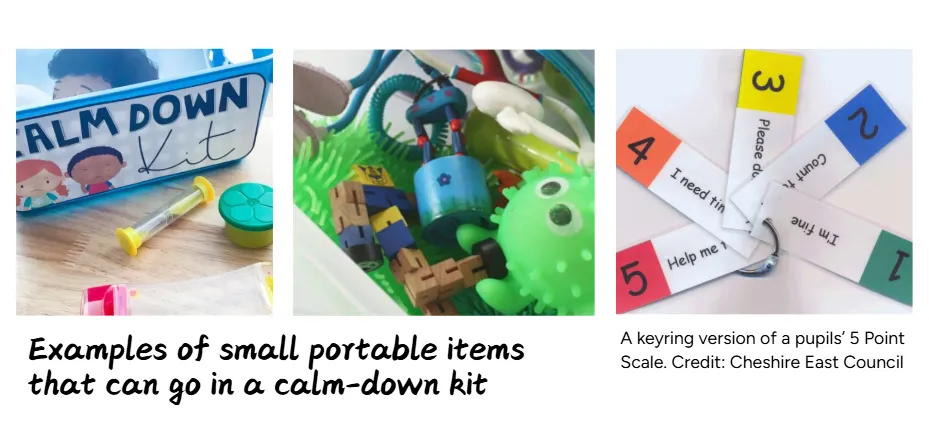
Incredible 5-Point Scale
The “Incredible 5-Point Scale,” developed by Kari Dunn Burton and Mitzi Curtis, is a highly effective visual tool used to help children understand and manage their emotions, social interactions, and responses. You can read more about how to get the most out of the tool in our dedicated blog here.
Jo’s top tip: Although a template for a 5-Point Scale can be a good starting point, the most effective 5-Point Scales are personalised around a theme that the child will enjoy and recognise.
Calm down kits
Teach the child how to use this in advance, then if they feel emotionally overwhelmed they can grab their personalised kit. They also satisfy needs such as sensory-seeking behaviours. Eventually it’s likely possible to reduce the number of things they need and frequency at which they need to access them.
Matthew’s top tip: Think portable wherever possible. Relying on a large folder/sheets of paper/ or a heavy calm down kit that can’t be slimmed down into a portable unit limits the contexts it can be used in. Aim for lanyards/keyrings/lightweight boxes that can be easily used in other contexts, such as in assembly, at lunchtime or the playground.
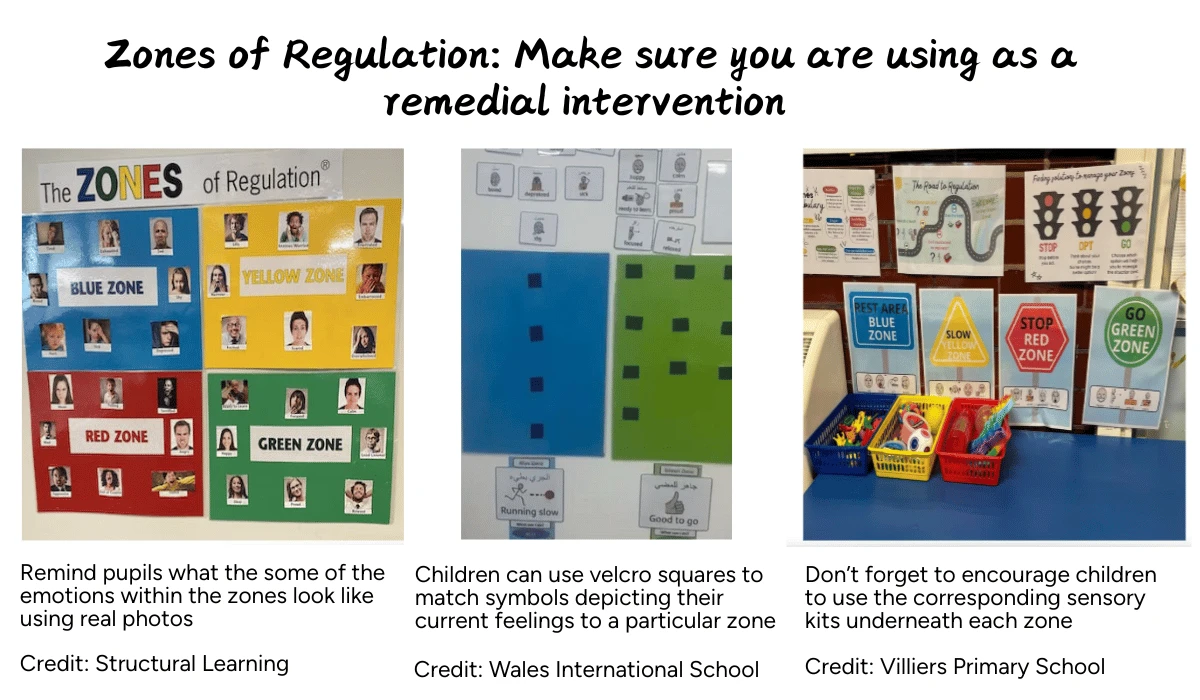
Zones of Regulation
Make sure you are not falling into the habit of just using this as simply a daily check-in activity; make sure it’s being actively used as a remedial tool and that it’s personalised to the children who need it most. Some autistic children may need pre-teaching and it’s advisable to build up to a range of emotions and explicitly name them, for example, “it looks like you’re feeling excited”. Avoid the situation where pupils get hung up on ‘happy’ or ‘sad’ because they are the most commonly taught expressions and assumed to be the correct answers.
Matthew’s top tip: Make sure pupils know how to use the sensory kits that go underneath each zone to help them move on from just labelling emotions to actually being able to bring themselves back into the green zone. It needs to be at a child-friendly height, and where the behaviour might be triggered, such as lining up for lunchtime or in group work/play areas, as well as in the classroom. This can be backed up with laminated personalised versions of Zones that can go on desks or tucked into workbooks.
Calm down corners
Make sure they are adaptable to the needs of the child. As explained earlier, some children might need sensory deprivation to feel less anxious, others might feel more secure with brightly coloured rooms and textures in order to gain stimulation.
Jo’s top tip:Plastering the walls with too many posters and calming strategies tends not to be that helpful for many children. It is often too generic, too wordy or too distracting. Instead, focus on providing something individualised and independently accessible, like personal calm down kits. These will need to be built up over time and used in the calm times as well as times of greater need, often with support from an attuned adult.
Behavioural lanyards
These can work for some pupils, but make sure communication can flow two-ways and that they are safe to use with a particular individual as they can encourage yanking on teacher’s necks! The teacher can wear a lanyard that tells the child how they are feeling and the pupil can signal on their own lanyard their emotional state by way of return, or what they want and need.
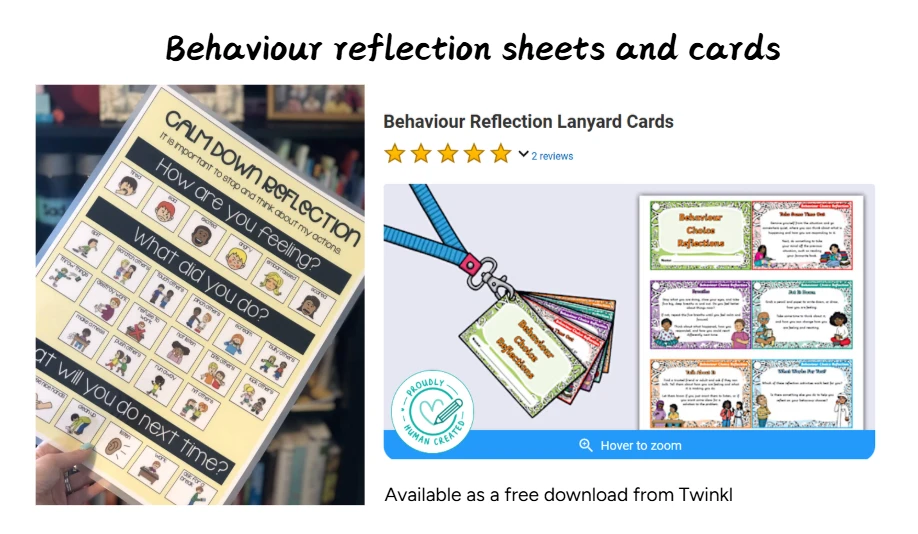
Reflection cards and restorative practice
Many children with special educational needs are capable of reflecting even though they may tell you otherwise. Thinking about what happened not only helps with what to do next time, but also assists children to cool down more quickly and prevent behaviour from escalating further. Comic strip conversations and reflection lanyards, such as the one from Twinkl below are a good example.
Nick Burnett and Margaret Thorsborne have written extensively on the topic of taking this a step further with restorative practice and this article in the European Forum for Restorative Justice has some great tips and case studies. Tes also have a free download that uses Widgit symbols to guide pupils through each stage.
Social stories
Used to help pupils understand social norms, social stories emphasise the positive action behind a particular behaviour (e.g. keeping our hands and feet to ourselves) and why it is desirable. They can be used as a pre-emptive tool and are really useful for helping reduce anxiety and overwhelm around major transitions to pupils, but also can be used as a reflective tool (i.e. what should have happened).
Jo’s top tip: Co-created social stories are much more impactful and effective – the child may even like to draw what they picture is happening as you explain each step. Try not to recycle off-the-shelf examples.
Final points to remember
Ultimately, the goal of SEMH support, as highlighted by Darleen, Jo, and Matthew, is to create lasting change. This requires a three-pronged approach to implementation:
Ground in understanding: Ensure that every strategy is meticulously tailored to the individual pupil’s unique profile and needs.
Promote autonomy: Prioritise the development of pupil independence so they can utilise support strategies successfully on their own.
Teach proactively: Maximise the effectiveness of all strategies by teaching and practicing them before a crisis occurs.
About our contributors
Darleen Grimsby is the SENDCO and Inclusion Officer for Unity Education Trust. Her current research project is centred on providing mental health support for non-speaking autistic individuals, an area she is deeply passionate about. She has recently published a book Developing Educational Plans for Learners with SEND: How to Support Speaking and Non-Speaking Children in All Settings that provides practical ideas and resources to develop educational plans for learners to allow them to access the curriculum.
Matthew Lee is currently Vice Principal at Wales International School, shortlisted for the Tes International School of the Year 2025. He has been a senior leader in multiple award-winning inclusive international schools and has a strong background leading in both mainstream and specialist settings. He has been widely published, and writes about pastoral structures, leadership challenges and supporting marginalised groups in international schools. Matthew currently tutors on our iSENCO award.
Dr Joanna Wood is a practising Senior Educational Psychologist, and leads a team of educational psychologists at our sister company, Real Psychology. She is also a module leader on Real Training’s Senior Mental Health Lead Advanced Award. Prior to becoming an Educational Psychologist, Joanna spent fifteen years teaching in London secondary schools, including as Head of Science in a PRU.




What do you think?