Imogen Barber |
September 15, 2026
By Dr Sarah Musgrave, Educational Psychologist
Back in June, the Government set out its guidance for setting up inclusion bases. I felt heartened to see belonging referenced so often in this report and indeed throughout the Government’s wider SEND strategy.
Inclusion bases are not anything radically new. Yet the DfE’s own research, and my own experience as an educational psychologist, paints a varying picture of success. A strong, integrated base can uplift the entire school; a poorly integrated one risks creating an isolated, parallel community.
One important point to raise before we go any further is that for all bases clear entry/exit criteria are vital. This is especially true for bases predominantly focused on supporting pupils with SEMH needs. Mainstream teachers and pastoral leads should have the confidence and support to unpick challenging behaviour and rebuild relationships before making referrals. Packing children off to the base at the very first sign of disruptive behaviour signals that they simply don’t matter to mainstream staff and there’s no place for them there.
As a practitioner psychologist, I am drawn to the psychological principles underpinning successful inclusive provision. Starting with how we would want children to feel is a good way to frame our approach to inclusion bases. Below, I explore what we can learn from Self-Determination Theory (SDT) about developing confident, independent learners who can thrive in the mainstream, supported by a wider culture where pupils can feel they genuinely belong.
Pseudo-belonging versus genuine belonging
Belonging cannot be achieved simply by placing a child in a room or an “inclusion base.” It is built through authentic, attuned relationships; remembering that this student goes by “Paddy”, not “Pat” or “Patrick”, and knowing not to bring up the Arsenal match in an insensitive way because their team lost at the weekend.
Neurodiverse students may be much more likely to experience “pseudo-belonging”, where a child is required to ‘fit in’ or suppress their needs to blend into a mainstream culture. This differs from genuine belonging, where the environment and community adapts to and celebrates the individual so they can bring their “whole self” to school without fear of rejection.
A good inclusion base offers such authentic connection, where staff validate pupils’ identity, understand their triggers and can keep them in mind. Yet some recent doctoral research suggests that even when this is in place, many students may still feel “split-context belonging”, where the base offers security, but also “othering” from the mainstream and a sense of dual identity.
To address this, systems and values in the mainstream and base should be aligned from the start. This is a huge topic, but I want to zone in specifically on something that can aid belonging across both base and mainstream contexts, and that’s building intrinsic motivation.
Self-Determination Theory: How improving intrinsic motivation can enhance belonging
I find Self-Determination Theory (SDT) a helpful lens to support inclusion and integration between mainstream and support bases. First developed by US psychologists Edward Deci and Richard Ryan in 1985, SDT is a framework of human motivation that helps us understand how people thrive and become intrinsically driven to act, rather than being compelled by external motivators.
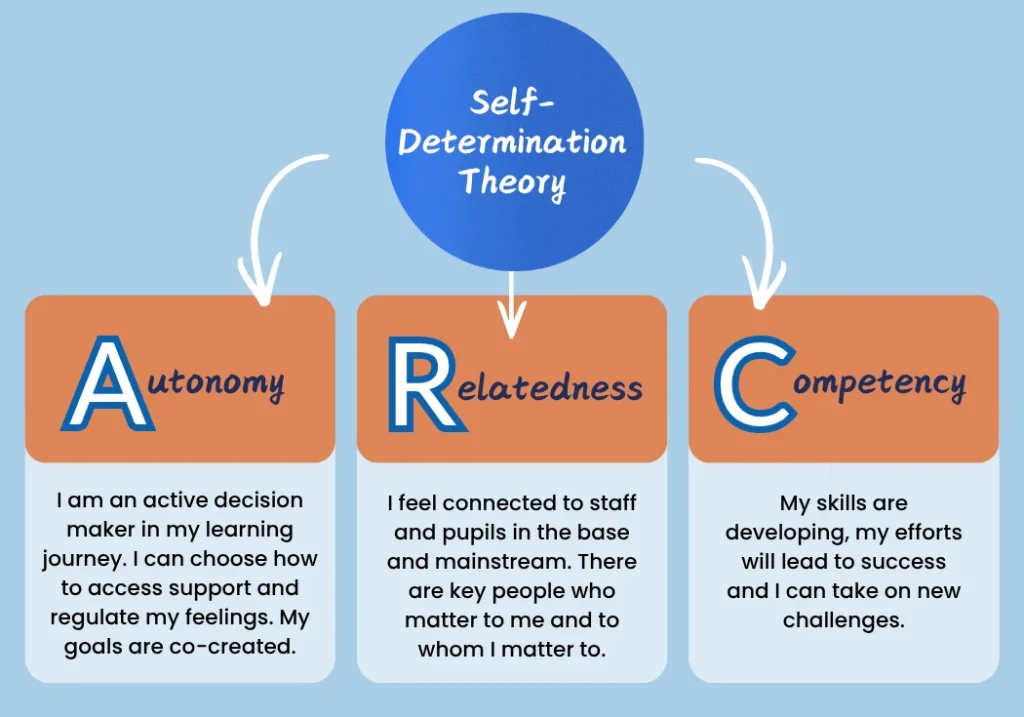
In this model, intrinsic motivation is built through autonomy, relatedness and competency, which work in tandem to help learners thrive, improving both overall wellbeing and academic achievement. Many schools I talk to find it useful to think of the acronym “ARC”.
When these elements are in place, a positive feedback loop is created, shifting the interaction with the school environment and helping pupils to feel like they can genuinely belong.
Building such a “drive from within” can change the way a student sees themselves. It equips them to use the base as a stepping stone to help achieve their personal goals, and better connect with, not disengage from, the wider school community.
1. Autonomy
I feel I have some control and choice in my work, my environment and what I like to do to stay calm
Autonomy is the psychological sense of agency, the ownership over the learning experience and the feeling that actions are self-authored and align with one’s goals and identity. It does not necessarily mean working independently, but rather having the self-directed ability to know when and how to seek help.
Often, neurodivergent pupils’ experience of mainstream schooling has been heavily controlled, eroding their sense of autonomy. Reversing this requires intentional shifts: providing structured choices, stepping back excessive teaching assistant support, and engaging in collaborative goal-setting and coaching. Together, these practices build self-regulation and self-initiated problem-solving capabilities that leave pupils better prepared for mainstream classrooms.
Whether issues around autonomy get better or worse in the inclusion base largely comes down to culture. If adults fear intense scrutiny or pushback from SLT, then they may inadvertently restrict choices and tighten up behaviour management policies. It is important, therefore, that leadership set clear expectations but also empower staff in the inclusion base.
Building autonomy does not mean offering freedom without any framework or structure (this would be unsettling for neurodiverse learners) but offering a degree of self-governance within adult boundaries. Here are some ways we can offer this.
Providing real choices within structure
Bounded choices allows pupils to take a degree of ownership of their school day. For example, could we provide structured options for when and how they want to take sensory breaks, or use various scaffolds and assistive technology? Could we provide the ability to choose from a range of settling-in activities available after lunch, or where they can spend some of their breaktimes and with whom?
Giving pupils agency over how they demonstrate learning is also important, such as dictating thoughts, creating a mind map, comic strip or labelled diagram, or delivering an oral presentation. Small things, such as emailing lesson slides in advance, gives students the option to prepare early, fostering greater autonomy. This practice could be rolled out from base classes to the mainstream, where pupils could choose to prep answers to a limited number of questions to reduce being put on the spot.
It’s important to clearly indicate where choice is possible, and where it is not. Many specialist bases already make good use of colour-coded visual timetables, for example, to explicitly distinguish between flexible, choice-led sessions and structured, non-negotiable routines.
Making sure our language reflects autonomy
This involves focusing less on directives and more on invitation and rationale. “Would you like to pack up now or in two minutes when the timer goes off, as long as your workspace is clean before the bell?” You can also give pupils a choice of how to use the space; “You can follow from your desk or move up to the front row so you’re clear on the steps for the task.”
Validating emotions and offering choice of self-regulation strategies
Many of the neurodivergent pupils in a recent study, especially those with ADHD or dual diagnosis, emphasised the importance of being able to choose their own self-regulation strategies and also that staff validate their right to express frustration and distress as a legitimate emotional release. To truly support these students, we need to pause and acknowledge their emotions without accidental dismissal. This also means thinking before using “conversational erasers” like the word “but” (e.g., “I know you’re frustrated, but we need to get on with our work”), which, in some contexts, can instantly undo the empathy we are trying to show.
Ask yourself:
- Where can specialist teachers increase a pupil’s sense of agency, while still providing the safety and security of adult boundaries?
- How comfortable are specialist and mainstream teachers with enabling autonomy for our pupils? Are the same (or similar) strategies in place across both contexts?
- Are SLT actively endorsing this while setting clear policy boundaries and expectations?
2. Relatedness
I feel connected to peers and adults in the base and mainstream and that I matter to them
Relatedness is supported when people take a real interest in what you do, listen with compassion, and remind you that you truly matter. It means we need to think beyond making pupils feel welcome, secure, and connected, and consider how we show them that they are appreciated, can be depended upon by others and that we want to invest in them.
Although building intrinsic motivation is vital, we cannot solely place the locus of change on the pupil and their environment. We also need systems in place to tackle bullying and “othering” from mainstream peers. It is important to consider how we are monitoring potential stigma that may be attached to pupils from the base and addressing this through neurodiversity-affirming workshops, or whole-school assemblies.
The DfE rightly acknowledges that inclusion bases exist across a “continuum model” and there is no one-size fits all approach to mainstream integration. That said, pupils in the majority of bases need to feel that they are valued members of both classes: base and mainstream. And for those who don’t identify with being part of a mainstream class, for example, a child who is spending the vast majority of their time in a specialist base, it’s important we provide alternative opportunities for socialisation as well as roles, responsibilities and recognition in the wider school context.
Flexible contact with mainstream peers
I would suggest that two things always underpin your strategy for maintaining friendship groups with the mainstream class: co-developing an approach with pupils and making sure you are offering some flexibility (within set boundaries). The former means asking ourselves; are we actively using feedback on practical aspects of the base as well as really listening to pupils’ experiences as an ongoing process?
There are a range of techniques we can use to capture pupil voice, from Drawing the Ideal School (developed by Heather Moran) to using pupil choice cards, such as this great example from Inclusion Partnership, or for older pupils, the Diamond Ranking Activity. This can complement standardised Belonging questionnaires and should be evidenced back in “you said, we did” communications.
Following on from this, we need to make sure we can offer flexible choices to accommodate pupil preferences wherever practical. For example, one secondary school in London allows pupils to extend invitations to a small number of friends and/or siblings from mainstream classes to come into the base whenever they want to share lunch. This helps convey to pupils that their preferences matter and their friendships are valued.
Of equal importance is more structured timetabled sessions with peers. I’ve observed some challenges regarding friendship opportunities with mainstream peers, especially in primary SEMH bases; set times each week for engagement with friendship groups can help. For secondary pupils, this might look like more time to participate in vertical bonding structures; house systems, daily responsibilities that come with being a school council member or assembly tech lead, or bringing all pupils together for form time or school trips. In some contexts fluid integration may be appropriate. In the school mentioned above, mainstream peers can be invited into the base to view project showcases e.g. animation shorts, attend lunchtime clubs and small numbers can take part in shared projects such as gardening, when it doesn’t disrupt mainstream lessons.
To help pupils feel like they matter, as well as belong, we can focus on low-pressure teambuilding activities, using cooperative learning structures, that encourage equal participation and coming together for a shared purpose, with clear roles and responsibilities during these sessions.
Peer support (neurotypical and neurodivergent)
As pupils get older, they may appreciate having a choice of how to access mentoring and buddy schemes. One option is peer support from neurodivergent pupils, especially those spending the majority of their time in the mainstream. A framework that has recently been developed for this is NEST. Co-developed by neurodivergent pupils and researchers from the University of Edinburgh, NEST peer groups have shown some signs of early success, albeit in a very small number of secondary schools in Scotland.
One autistic pupil noted how it has allowed him to feel a sense of purpose: “For me it is kind of fulfilment…I am influencing younger people in a good way and not in a bad way. I am trying to prevent letting people grow negatively.” Others describe the positive benefits as requiring less need to mask and being able to access a non-judgemental space for making friends.
Trusted adults in both mainstream and inclusion base
From birth, children need a key adult to act as a “secure base” from which they can take risks and explore the world. In the early years, this relationship is fulfilled by a parent or caregiver, but at school, access to adults who can act as a secure base is also important.
Learning involves taking risks and children need to know they can return to that adult for reassurance without judgement. This is why the best resourced provision I’ve seen often operates using a model where the mainstream teacher retains some degree of responsibility, not only for work that’s set, but also for overseeing and maintaining that secure relationship with a pupil, often through a system of check-ins or one-to-ones.
Both secondary pastoral leads and mainstream primary teachers are typically encouraged to use the Establish, Maintain, Restore approach as a way to explicitly focus on relational inclusion. Pupils using the base shouldn’t disappear from these frameworks, but closer liaison with specialist teachers may be required. Some schools use early pupil finishes on Fridays to create additional time for non-teaching pastoral leads and SLT to have high quality reflective practice (supervision) to discuss this.
Opportunities to connect with staff during transitions
We also have to think about a possible sense of loss when time-bound placements in bases come to an end. Phased transitions and buddy grouping for return to the mainstream may work well. Depending on the type of base, we could also consider turning the model on its head so specialist teachers or TAs have some timetabled time to come and visit pupils in their mainstream class.
Moving away from punitive disciplinary systems
Children naturally internalise the values, expectations, and behaviours of the social groups they feel deeply connected to. If a student feels sent to a base as a punishment, their sense of relatedness to the wider school ruptures. They comply only out of external regulation (fear of consequences) or introjection (shame). Restorative approaches preserve a child’s place in the community, and consistency of practice should be the goal across base and mainstream.
Ask yourself:
- If this child felt they truly belonged here, what would we notice them doing differently?
- How will we allow for mainstream teachers to have the required contact to conduct meaningful check-ins with their pupils?
- What core social experience is this child missing right now while they are out of the mainstream class?
- When a pupil makes a mistake, do our disciplinary systems repair the relationship or rupture their connection to the school?
3. Competency
Intrinsic motivation peaks when a task is pitched at the optimum level of challenge, balancing psychological safety with cognitive challenge.
When a base lowers its academic horizon to simple tasks that are too easy for students, it signals to them that they are incapable. Competence isn’t built by avoiding the national curriculum; it’s built by making high-level content accessible, which is only achieved by collaboration between specialist staff and mainstream teachers.
Understanding how the base is perceived both by pupils currently using it and the wider school is a good starting point. Do students feel like it’s a place where they aren’t experiencing meaningful progression towards getting the grades they need? Does it carry a wider stigma as a place for less able or “slow” pupils that needs to be addressed through mainstream assemblies and workshops?
We also need to consider how well we’ve communicated the base’s purpose and curriculum to parents. Clear communication helps ease fears about lowered expectations, which parents might otherwise unintentionally pass on to their children.
Practical approaches will vary depending on pupil need and type of base, but some things we could consider;
Subject-mapping frameworks
Where appropriate, subject mapping can be highly effective. A mainstream Year 8 English lesson on Macbeth could be replicated in the base by covering the exact same scene and plot points, but using graphic novel adaptations, audio-assisted reading, or sentence-stem scaffolds. This won’t be appropriate for every type of base; tasks set must still match pupils’ language or abstract reasoning skills and not exceed the developmental capabilities of the child.
Embedding effective scaffolds into your universal offer
Often things like task boards, visual instructions and other visual supports are absent from secondary classrooms, and yet this relatively small piece of structure can be absolutely pivotal for helping neurodiverse users (and many other pupils) to get started with their work.
Informational feedback and attributing success to effort and strategy
Generic praise “brilliant job!” does little for competence. Competence is built on specific, informative feedback: “You remembered to use your sound card for those three words – that made your spelling much clearer” and praising the effort, not just the outcome.
Dual teacher planning
Base staff regularly sit with mainstream Heads of Department to look at work produced in the base alongside mainstream samples. This prevents “drift” toward low expectations.
Ask yourself:
- How are we capturing what students think about the base and how it reflects on their level of competence?
- Are we encouraging parents and students who have used the base to share narratives around positive outcomes?
- Are the frameworks we currently use to develop a pupil’s sense of competence and fade out adult assistance working well?
A “powerhouse” for inclusive practice
Realising this vision requires considerable time and may demand a rebalancing of priorities, particularly while aligning systems between the base and mainstream provision.
A coordinated effort is a worthwhile investment. Whether functioning as “inclusive services” or “safe havens”, bases can become powerhouses for boosting student confidence, spreading specialist pedagogy and enriching mainstream practice to benefit the entire school community.
This shift only happens, however, if we foster intrinsic motivation and a genuine sense of belonging for pupils and staff alike. Base staff must never feel like “a spare part in someone else’s school” – a comment reported by one staff member in recent research looking at resourced provision. Staff in inclusion bases need to feel seen and heard and that they matter.
Shared physical and online spaces for collaboration as well as established ways to recognise and share success will become key here. We might even make changes to our staffing models. One secondary school in Bradford, for example, places mainstream teachers on annual rotation between the mainstream class and their support base, (which follows the same curriculum) allowing every teacher to deepen their experience supporting SEND. In addition, TAs are fluidly deployed across both their support base and within the mainstream, depending on pupil need, as well as within the specialist foundation class which follows an adapted primary curriculum led by a primary teacher.
Every school’s set up will be different. What’s important is to provide staff with the following;
- the autonomy to flexibly adapt provision, act on pupil voice and draw on creative solutions.
- the right specialist training, complemented by curriculum guidance and support from mainstream teachers, to enable them to feel competent returning children to the mainstream
- a sense of relatedness and connection to the rest of the school that enables them to feel part of the same community and well positioned to influence school-wide practice.
Whether you are in the process of establishing, evaluating or improving your inclusion base offer, I would suggest that bringing things back to these core principles of autonomy, competence, and relatedness is an incredibly useful way to anchor your decision making. It is an approach that can serve your whole school community well.
References
Sheridan, L. (2025) Exploring the Role of Belonging in the Inclusion of Students Attending Specially Resourced Provisions for Autism and/or Speech, Language, and Communication Needs in Mainstream Secondary Schools. Doctoral thesis (D.Ed.Psy), UCL (University College London).
Pavlopoulou, G., Chandler, S., Lukito, S. et al. (2025) Situating emotion regulation in autism and ADHD through neurodivergent adolescents’ perspectives. Sci Rep 15, 37464.
Crompton, C. J., Fotheringham, F., Cebula, K., Webber, C., Foley, S., & Fletcher-Watson, S. (2024). Neurodivergent-designed and neurodivergent-led peer support in school: A feasibility and acceptability study of the neurodivergent peer support toolkit (NEST). Neurodiversity, 2. https://doi.org/10.1177/27546330241275248
Warren, A., Buckingham, K., & Parsons, P. (2021) Everyday experiences of inclusion in Primary resourced provision: the voices of autistic pupils and their teachers, European Journal of Special Needs Education, 36:5, 803-818.
Useful resources
The following toolkit for resource provision from the University of Southampton offers practical strategies for primary schools: Strogilos, Vasilis, Barron, Cleo and Ward, Becky (2023) Inclusive provision for students with special educational needs and/or disabilities: a resourced provision toolkit Southampton. University of Southampton
The Neurodivergent Peer Support Toolkit from the Salvesen Mind Research Centre at the University of Edinburgh can be downloaded here: https://salvesen-research.ed.ac.uk/resources/nest-neurodivergent-peer-support-toolkit
About Dr Sarah Musgrave
Dr Musgrave joined Real Group as a senior educational psychologist with over 10 years experience working within a local authority and 20 years experience in the education sector. Her interests lie in positive psychology approaches and looking at the conditions required for children and adults to flourish. She provides psychological services to schools via Real Psychology and is a tutor on our MEd programme and the Certificate of Competence in Educational Testing (CCET) course.




What do you think?