11 Things We Learned About How the Schools White Paper will Reform SEND
Imogen Barber |
February 25, 2026
Share to
On Monday, the government released its major new white paper for schools, representing the biggest proposed shake-up to SEND policy in the last decade.
We believe the intention to increase direct, early access to expert support and make inclusion a priority in all mainstream schools is a positive step forward, as is the commitment to placing evidence-based practice front and centre for every child.
The white paper aims to fix a system characterised by an escalating demand for EHCPs as the primary mechanism to access fully resourced SEND support. Whilst there is excellent practice happening across our schools, access to significant funding remains, as the white paper observes, “locked behind bureaucratic statutory processes”. Too many children face delays getting all their needs met, overwhelmed parents often feel like they have no choice but to fight tooth and nail for an EHCP, and council deficits are on track to hit £6 billion.
With EHCP requests more than doubling over the last decade, the backlog has reached a point where one in 14 children are waiting over a year for extra help. Meanwhile, time from specialist professionals has been funnelled into activities such as EHCP applications, detracting from their capacity to help school staff with early intervention and support for children with additional needs.
The white paper sets out proposals to change this, focusing on building capacity to support more children in mainstream environments, before re-calibrating the SEND system as we know it.
Here are some of the key points, plus the questions we think are yet to be answered.
1. Digitised Individual Support Plans (ISPs) for all children with SEND
The government intends to strengthen the “universal offer” for all children through a £1.6bn Inclusive Mainstream Fund, backed up by SEND training for school staff, good use of adaptive teaching, improved school environments and enhanced enrichment opportunities.
Should pupils need additional help beyond this, it is proposed that schools, nurseries and colleges will have a statutory duty, (once the law has changed) to record this in an Individual Support Plan (ISP). These digital documents will be created collaboratively with parents, with outcomes reviewed at least every 12 months. They are likely to be included in Ofsted inspections.
Crucially, pupils on ISPs will be able to access time with specialists (educational psychologists, speech and language therapists, occupational therapists etc.) without having to wait for a diagnosis to access support.
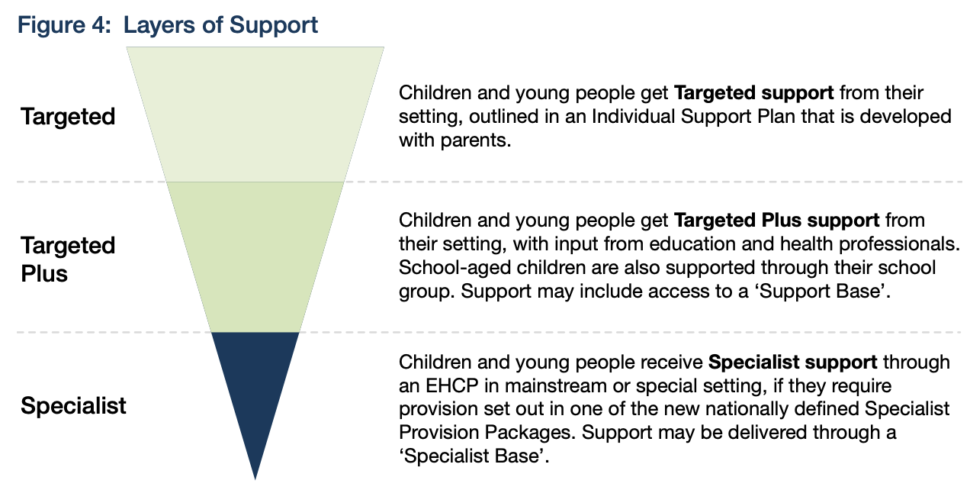
Tiers are as follows:
Tier 1: Targeted. Structured support will be provided by schools using a clear, trusted national framework. Needs will be documented and reviewed using the Individual Support Plans (ISPs). For example, small group interventions for speech and language support.
Tier 2: Targeted Plus. More specialist support for children delivered by SALT, EPs or OTs. Children in this tier may spend time in the school’s inclusion base. They may also have a short-term placement in an AP (Alternative Provision) or special school.
Tier 3: Specialist Support (which forms the basis of new EHCPs). Reserved for children with the most severe and complex needs. There are seven types of Specialist Provision Packagescurrently mooted, although this is still being worked on. Children on a specialist package will have an EHCP, but their day-to-day details of support will be recorded through their ISP. They will be consistent across the country, ending the current “postcode lottery.”
It’s worth re-emphasising that no changes to the support given by EHCPs will begin before September 2030.
What remains unclear: The big questions here concern the extent to which the threshold criteria for obtaining an EHCP will change, as well as what the individual price bands will be for each package. It will be interesting to see how far the specialist provision packages will be able to flexibly accommodate the needs of each individual.
The ultimate long-term aim of the whitepaper, however, is to bring down the number of children on EHCPs not simply by setting the bar higher, but by increasing effective support in schools and therefore reducing the likelihood that a child will need one.
2. New National Inclusion Standards and an updated Code of Practice
There will be a new national framework of high-quality, evidence-based interventions that every school can draw upon to develop ISPs. This will be drawn up by a panel of experts who can summarise the evidence on “what works” for teachers, and is expected to be in place by 2028.
Each year, schools will be required to produce an inclusion strategy (replacing the current SEND Information Report) detailing how they meet these national standards and are using their funding. This will be subject to Ofsted inspections.
The new proposed areas of development; (formerly areas of need) in the updated Code of Practice include difficulties with executive function, motor and physical, sensory, speech, language and communication and social and emotional categories, in order to support needs-led provision.
What’s still unclear: Changing the “areas of need” to “areas of development” in the Code of Practice is an interesting and positive idea, however the proposed categories need further expert and sector scrutiny, as do the Specialist Provision Packages. It isn’t clear, for example, how mental health support will sit under the new packages. It is also unclear how children with development needs that span two or more areas will be provided for.
3. EHCP reassessment in Year 6, 11 and 13
It is proposed that, from 2029, children issued with a Specialist Provision Package will be reassessed at the end of primary school, and again before they leave each subsequent phase of education.
But there will be a “triple lock” of protections for children while the system is being updated.
The reassessment will only come into action in September 2029, meaning children currently in Year 2, for example, will be the first cohort to be reassessed in Year 6. Early Years children with an EHCP will not be reassessed until the end of primary school.
Transfers to the new system won’t happen until a full academic year later however, in 2030, when ISPs should be fully up and running. Children will keep their existing EHCP in the interim period.
There are no plans to change provision for children who currently have a place in a special school.
Our thoughts: While logical, reassessing children at the beginning of Year 6 could have its drawbacks. It is unlikely that primary school teachers or parents would respond positively to plans to withdraw an EHCP at a sensitive time when children’s needs often are changing. It could also be a source of additional anxiety for children preparing to start Year 7.
Building parental confidence in the ‘Targeted’ and ‘Targeted Plus’ categories is vital. Implementing the ‘Experts at Hand’ initiative (explained later below) and proving its efficacy before 2029 will be key to building effective capacity to meet children’s needs early and establishing trust in the system.
It is also worth noting that once the new system is up and running, EHCPs won’t be reviewed annually, as is the case currently, but between each Key Stage.
4. Schools to form ‘SEND Groupings’ with direct control over new inclusion fund
In a major departure from the current model, mainstream schools will be given their own commissioning budgets for SEND support. The government is making £1.6bn available for three years as part of an Inclusive Mainstream Fund.
Schools are expected to form local “clusters” within the next three years to pool this funding so it can be used effectively. The longer-term objective is for all schools to become part of a trust.
The white paper says this funding is to “develop targeted, evidence-based support offers such as transition programmes or group interventions – without requiring formal assessments or diagnoses.”
What remains unclear: We don’t know whether there will be a minimum size for these clusters, or how schools will be expected to negotiate how budgets and resources are split. There may be concerns around what happens when the pool is used up and how to handle in-year admissions. It’s also unclear what funding will be provided after the three years and whether it will be sufficient to retain and grow the TA workforce needed to help support it, on top of things like the additional therapist time and assistive technology that might be required.
5. £1.8bn to create a bank of specialists, known as “Experts at Hand”
£1.8bn will be set aside between 2026 – 2029 for Local Authority commissioned support services such as educational psychologists, SALT, occupational therapists, etc. These will be called “Experts at Hand”. The fund is further divided into a £1bn pot for expert professionals and £800 million for outreach services, provided by special schools.
The government says this will equate to roughly 40 days of expert support for an average primary school and 160 days for a secondary school each year.
Earlier in February, the government announced that they plan to train at least 200 educational psychologists in 2026/2027, with more funding to follow in 2028.
Our thoughts: A major consideration will be how quickly will the SALT and EPs currently working in the system will be able to refocus their capacity and resources to support children earlier in the school system? Will enough specialists be available to deliver effective early support and manage the ECHP reassessment process? The number of new EHCPs is expected to rise until 2030. Add to this the additional reassessment work from 2029 and the demand on EP time will be significant. Some industry voices have also raised concerns about the availability of staff in special schools to provide outreach.
6. Parents retain legal right to appeal, but tribunals won’t be able to name a school
Parents will retain the ability to appeal decisions, such as whether a child should be assessed for an EHCP as part of a Specialist Provision Package, and which school the child should attend.
However, the document accompanying the white paper: SEND Reform: Putting Children and Young People First mentions that tribunals will not be able to name a school placement for a child.
If parents are not happy with what’s in a child’s ISP, they will have to go through a school complaints system first, before being able to complain to the Local Authority, or to the government. This will now have to include an independent SEND expert on the panel. A new digital system for managing complaints will be introduced.
What’s still unclear: If the law changes, will the impact of a tribunal losing the power to name a school placement result in significantly fewer appeals? Could this change support a renewed focus on the importance of the pupil’s current school and parent working effectively together?
7. Inclusion bases in every secondary school
As already announced a few weeks ago, a separate £3.7bn fund will go towards creating new inclusion bases that will replace what’s currently known as SEN units, resourced provisions, and pupil support units. They will provide tailored learning environments and equipment and will be separated into:
Support bases (school/MAT funded) and
Specialist bases (LA funded)
What’s still unclear: How schools should update their policies around who should access the inclusion base to avoid inappropriate referrals. If a child’s needs cannot be effectively met within the school’s support base, what will be the mechanism for reassessing the move to a specialist base?
8. £200m SEND CPD package
This was announced in advance of the white paper and will cover training for professionals in nursery, primary and secondary and FE settings.
There’s also a commitment to continue working with the EEF and promoting evidence-based practice which we fully support.
9. National Price Bands for independent special schools and greater curriculum controls
New national “fee bands” will be set for different types of Specialist Provision Packages. They are expected to be fully implemented from 2029 onwards.
While reports leaked prior to the white paper suggested a cap of £60,000, the official white paper focuses on these “price bands” which will vary depending on the complexity of the child’s needs.
What’s still unclear: Could the proposed National Price Bands for independent special schools pose a risk that these schools may decline to meet the needs of some pupils, potentially forcing Local Authorities to incur higher costs by establishing new, urgent, or alternative provision?
10. New inclusive progress measure and updates to School Admissions Code
The white paper recognises that “we need to ensure breadth is recognised in our accountability system” and so proposes to consult on including more creative subjects in Progress 8.
To ensure that access to high-performing schools is not dependent on household income or local house prices, the government will develop new resources to encourage schools to adopt more inclusive admission arrangements, while tightening the rules to ensure banding produces representative intakes. This builds on existing tools in the code that allow schools to prioritise children who are eligible for the pupil premium.
11. Measuring belonging to become compulsory
A new Pupil Engagement Framework will be published by the government later this year and all schools will be expected to measure belonging. There is strong evidence that a child’s sense of belonging and their attainments are positively linked. We would all support the aspiration for children and young people to feel like they belong to their school, and so encouraging schools to focus their resources on supporting this ambition is helpful.
The white paper states: “We expect schools to make effective use of this data, highlighting evidence-based practice that can be embedded into their improvement plans, which not only improve engagement, but also support outcomes including attendance and attainment.” What’s still unclear: Will schools need to report on belonging scores for individual cohorts, such as pupils with SEND? Which standardised belonging indexes will be used?
What next for SENCOs?
Ask the experts: If you’re uncertain about how to prepare, join our webinar happening on Friday March 20th where we’ll be discussing the practical implications of some of the changes.
Have your say: The consultation is open for 12 weeks (closing 11.59pm 18th May 2026). The DfE has specifically asked for the views of “teachers and leaders.” This is your opportunity to have your voice heard. Respond to the consultation here:
Develop a robust communications plan: Parents will understandably be anxious, so schools should be developing a cadence of communications, as well as one-to-ones and drop-ins. When preparing content for SEND newsletters, asking AI to predict some of the questions parents may be thinking about might be helpful, especially as LLMs are currently digesting a lot of requests from parents who are keen to get their head around the changes.





What do you think?