The Connection Factor: How Schools Can Build a Sense of Belonging
Imogen Barber |
February 6, 2026
Share to
The past couple of years have seen a doubling down of effort to enhance pupils’ sense of belonging in schools, with links being drawn to wellbeing, motivation and absenteeism, as well as academic achievement.
Although particular targeted interventions show signs of promise, improving belonging typically involves whole-school systematic and cultural changes. This relies on building the right foundations, starting with relationships in the classroom. When relational inclusion is prioritised, we ensure every pupil feels valued, we demonstrate that their contributions matter, and we invite them into a shared sense of place and reference. There are no quick fixes, but backing this up with plenty of opportunities for cooperative learning, peer bonding, and strong inclusive practice can have a positive impact on pupils’ self-esteem and has the potential to improve their sense of belonging.
Lack of belonging an issue for UK schools – but potential signs of improvement
Data released after the pandemic illustrates the problem of belonging in UK schools. An analysis of TIMSS data between 2019 and 2023 has shown a stark decline in pupils’ emotional engagement with school after transitioning to secondary level; a drop noticeably more pronounced in England compared to other countries.
Lately, the picture is perhaps more hopeful. Survey results from the DfE’s Pupil Experiences in School report show a 12 percentage point increase in the number of secondary pupils stating they felt they belonged at their school ‘most or every day in the past week’ in May 2025, compared to the same time the year prior. Time will tell whether these green shoots of improvement can be sustained.
It’s worth remembering that the survey also showed that 16% of secondary pupils said there was “rarely” or “never” an adult who “really cares about me” in school, an improvement from previous years, but a demonstration of the work still to do. The problem of belonging is less pronounced in primary schools, but it is still something that needs to be addressed, especially amongst pupils with SEND.
Defining belonging
For clarity, we’re using the commonly adopted definition of belonging as “feeling personally accepted, included and supported by others in the school environment.” Reproduced in Goodenow and Grady, 1993.
An intentional system for maintaining positive staff-pupil relationships
You’d be hard-pressed to find a teacher who doesn’t value and pursue positive relationships with their students. Yet stretched timetables and the pressures of meeting targets can erode relationships over time. By way of example, a 2024 University of Bath report found that secondary pupils felt their sense of psychological safety and belonging was undermined by several factors, such as being put on the spot, having misunderstandings dismissed as ‘laziness,’ or being treated unfairly. These classroom experiences directly contribute to a wider sense of isolation from adults.
Dr. Larissa Gaias from the University of Massachusetts recommends that schools make time for an intentional approach to relationship building. “Relationships in general, regardless of their nature, without intentional efforts tend to degrade over time,” Gaias says, “we need intentional ongoing efforts to keep those positive relationships intact”.
Some things to think about, in order to follow Gaias’s advice include:
Revisiting the Establish, Maintain, Restore (EMR) method
While the Establish, Maintain, Restore (EMR) framework is a staple in many classrooms, its success relies on being fully embedded and prioritised across school, with staff given time to reflect. Segmenting pupil registers into establish, maintain or restore categories can help teachers and behaviour teams build a bigger picture of their student population, spotting not only individuals, but also trending groups of pupils that might need greater focus or coaching support. Categories are divided into the following;
Establish: For new pupils. Focus on getting as much background information as possible, “talk them up” to other adults, use activities to get to know them, send positive notes home, show genuine excitement for their presence, and give one-to-one time to establish psychological safety.
Maintain: For the steady middle. Don’t let them become “invisible.” Keep the momentum with low-stakes high-impact moves: warm greetings at the door, quick “weekend check-ins”, “this or that” voting for conversation starters, celebrating achievements, giving targeted, derserved praise and recognising effort, not just outcome.
Restore: For pupils where the bond has frayed. This requires the most intensive effort, prioritising empathetic listening, collaborative problem solving and structured restorative sessions to repair trust, including (where necessary) admitting when we may have overreacted or made mistakes.
Placing restorative practice at the heart of behaviour policy
Restorative practice is a key part of the EMR approach. While consequences for behaviour remain, it redirects focus away from re-instating obedience towards rebuilding relationships by listening to students. Moving away from punative punishment can be an essential part of helping students feel heard and fairly treated in school. A Teach First report noted that five out of the six secondary schools who scored highly on indexes of inclusion and attainment used disciplinary systems grounded in restorative practice.
Some schools quoted in the report above, ensure that if detentions have to be issued, they are always held same day so teachers can follow up with reflective conversations and an all-important fresh start the next morning. Others have appointed a designated Head of Year who has purely pastoral responsibilities to help immediately reset behaviour before punishment is necessary.
For restorative practice to work for all pupils, the process must be both accessible and adaptable. For neurodivergent individuals, traditional verbal scripting can be a barrier. Effective schools adapt this by using visual supports (like comic strip conversations) and ensuring students are fully regulated before attempting a restorative dialogue – even if that means waiting until the next day.
Finding a system to notice the good things
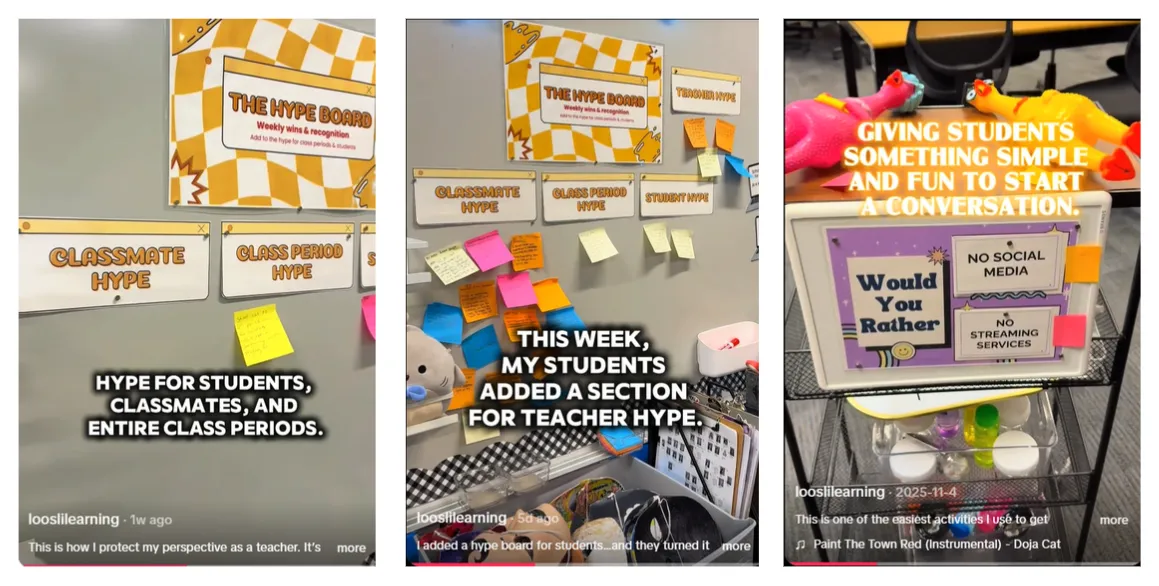
Simple visual cues, such as gratitude boards in corridors or ‘hype boards’ in classrooms, can serve as effective prompts for connection. By dividing these boards into sections for both teacher and student to leave positive sticky notes to recognise weekly wins and positive actions, teachers can build a regular habit of positive affirmation.
This example is from a US classroom, but still demonstrates a potential system to notice the good things. Credit @Loolislearning. Video available here
Tapping into a shared sense of place
Mariya Mobeen is an Assistant Principal in a large mainstream secondary in Bradford and Lead Tutor on our course, Educational Leadership through a Cross Cultural Lens. Her school has started offering tours of the local community to all new teachers. “We realised that staff who have the best relationships with students are those who know the community really well,” she says.
Mariya explains that, as well as encouraging a “shared frame of reference” so staff can easily converse with students about their lives outside of school, it can also make lessons more engaging. “A local area of interest can also be incorporated into geography lessons, a takeaway shop can raise a smile in a maths question – there are so many ways to show young people that their world matters to us too and to help teachers and pupils feel that they have this shared space and connection,” she adds. It can also help the curriculum feel more purposeful.
Regular staff training in trauma-informed practice and attachment
Most schools have some level of training, but this is not the same as regular scenario-based practice and a consistent shift away from “punishment” to both logical and consistent consequences for unwanted behaviour. Staff also need the headspace and skills to practice self-care and avoid empathy drain.
Peer relationships – we are like a family here
Many pupils report that having close friends and feeling respected by their peers is important for their sense of belonging. It is no great surprise, perhaps, that pupils who are persistently absent rate their ability to make friends as 15% lower than those who are not. Some things that can help include;
Peer-based restorative practice
Large-scale US studies have shown that the use of practices such as restorative circles can reduce feelings of victimisation and can strengthen a sense of belonging in schools (Eisman et al., 2020; Melendez-Torres et al., 2021). A trial of the Learning Together intervention at 40 secondary schools in the South East of England has also shown a significant reduction in bullying behaviour and improvement in wellbeing, compared to a control group.
Encouraging a “family ethos”
Several schools have had success trying to bring in elements of nurturing and caring relationships in smaller groups akin to those found in a family environment. In Mariya Mobeen’s school in Bradford they run an additional learning provision for students with educational needs. The numbers within this setting are smaller with a higher adult to child ratio. At lunchtimes, students participate in family dining where they are encouraged to take turns serving their group, rather than queuing up at the canteen.
“Pupils are seated 10-12 to a table, one person serves from a large dish, another fills the desserts, one person tidies up etc, and often teachers will come and sit with them,” Mariya says. “It’s a really lovely initiative that helps pupils bond and socialise over a meal and has been especially useful for helping children who have faced adverse circumstances before they join us.”
Introducing more circle time in primary and secondary contexts
Jenny Mosley, an educational consultant who specialises in circle time, observes that it has often fallen off the agenda of many lessons, even in primary schools, save those involving the very youngest pupils. Yet the pupils she interviews speak of how gathering with peers in a circle “gave me a family,” and headteachers often are surprised about how effective it can be to enable pupils to tackle emotionally challenging topics.
Exploring Circle Solutions
Circle Solutions is a pedagogy for encouraging healthy relationships developed by Dr. Sue Roffey. It is similar to circle time, but adheres to a more structured philosophy drawing on positive psychology, without reference to specific incidents. The aim is for students to take the lead and come up with solutions to real or imaginary scenarios, referring to people in the third-person. It is deliberately structured to allow many students to participate in small groups, while maintaining psychological safety and giving children the ability to impact their community.
Empathy training
Two things to highlight include the LEANS resource, designed to help students aged 8-12 learn about neurodiversity, and the Empathy Training programme for 5-18-year-olds run by Empathy Studios. The latter has been found to have positive effects on teacher-rated empathy scores, emotional literacy and curiosity about other cultures in a recent study conducted by researchers from Cambridge University. Interestingly, empathy training might benefit some teachers as well. A brief empathetic mindset intervention (using maths teachers at two secondary schools in England as participants) demonstrated a significantly postitive impact on students’ feelings of belonging, as well as reducing suspensions and detentions.
Creating more opportunities for cooperative learning
What if, every so often, we set ourselves the challenge of noting down how we might support a belonging objective in lessons alongside the learning objective? While there’s not a great deal of research linking belonging specifically to cooperative learning, there are a significant number of studies that show it can lead to reduced anxiety, higher self-esteem, and improved releationships with peers, compared to settings where it is not prioritised. (Johnson et al, 2000, Van Ryzin et al, 2020,Roseth et al, 2008). This only works, however, if participation is truly equal. Revisiting strategies like Kagan’s Cooperative learning techniques, and the Jigsaw method reduces the likelihood of pupil contributions becoming unbalanced and one or two students dominating.
Targeted interventions – I can grow my sense of belonging
Two very different, but established interventions, both involving aspects of positive psychology, include;
The social belonging intervention. Developed by a team led by Stanford psychologist Gregory Walton, the intervention has shown strong, reliably replicated results in the US, especially with students from minority backgrounds. Students starting school or college are shown survey results from older peers graduating in order to normalise the feeling of not immediately ‘fitting in’. The older students then go through guided reflection, enabling them to provide written or video advice to the younger students and explain how things can, and do, get better. Younger students who were exposed to this showed improved persistence, better mental wellbeing and were less likely to drop out of college. It is currently being trialled in four English secondary schools.
ELSA sessions. Research suggests that access to ELSA (Emotional Literacy Support Assistant) sessions can give pupils who feel isolated the skills to build and maintain relationships with others and develop a feeling of positivity in school (Bravery & Harris, 2009; Dunn, 2020; Purcell et al., 2023). A recent literature review in Educational and Child Psychology draws a clear link between ELSA and school belonging. Qualitative feedback captured in this 2024 evaluation summary shows headteachers report a wide range of anecdotal benefits, including increased attendance and self-esteem.
Inclusion and representation – other people like me belong here
A tokenistic approach to inclusion can widen the belonging gap. Mariya Mobeen emphasises that inclusion must be threaded throughout everything you do and recommends conducting a belonging and inclusion audit. “Try walking the school and asking yourself, what languages, what cultures, what festivals can you see within your school and how welcoming does it seem?” she says.
“If there’s a visual timetable, for example, are the words written in some of the students’ home languages as well? If you go to the library, can you easily find books with main characters that represent different faiths, cultures, socio-economic backgrounds, ethnicity, physical appearance, etc.? If you regularly attended assembly, would you have heard from neurodivergent people and those from different faiths or backgrounds – either directly or through narrative accounts?”
Some of the things you might ask yourself as part of this also include:
Can students see themselves in the trusted adults available? Of course, having a good representation in your staff base is the ideal scenario. Some schools have even taken to actively recruiting ex-pupils to school support staff, teaching and SLT positions to help improve this. If that’s not possible, look at what outside agencies you could draw upon for cohorts that need it most. At Mariya’s school, absenteeism amongst Eastern European students has been a particular problem. One of the initiatives that has been most effective involves using an outreach agency made up of staff from this particular community to do weekly group sessions with the students. They address issues around school absence and aim to make coming to school seem ‘irresistible’. This can include reward initiatives like bowling or a pizza party at the end of a series of sessions.
Are different voices represented in the curriculum? Are students only exposed to black history during one dedicated month, or all year round? Will they have studied a diverse range of authors by the time they leave school?
How are staff informed about student backgrounds? Consider holding regular practice clinics to share pupil profiles of new joiners with all staff, so that staff are aware of pupil backgrounds and experiences prior to joining.
Can neurodivergent students fully participate? Understandably, many pupils report that the ability to engage with the curriculum is an important part of feeling part of their school community. Researchers interviewing children with SEND aged 3-16 about belonging, identified teaching and learning as a key theme, alongside the environment, relationships and extra-curricular activities. Using inclusion by design goes a long way to address this, alongside a diverse curriculum offer, plenty of multisensory learning and well-designed spaces for learning and recuperation. When it comes to specific activities like reading, however, it may also involve offering greater choice, having dyslexia-friendly Barrington Stoke books readily available, for example, as well as the right specialist support.
Some changes might be small. To support students who need more processing time, a “heads-up” on a discussion agenda/outline might be helpful. Alternatively, a simple post-it note system can let that individual know you’ll remember to circle back to them if they want to contribute. There’s nothing more frustrating for a pupil than finding their voice just as the conversation shifts to something else. If you are asking questions or doing a brainstorming task, Dr Helene Cohen recommends pausing and letting pupils know that you’ll be asking for feedback after a certain ammount of time, in order to communicate there is no need for the pupil to be anxious about having to come up with an answer on the spot.
Building character and agency – there are many ways I can allow myself to belong
While low self-esteem can be caused by many factors, it can be triggered when students feel their value is measured through academic achievement alone. This can create a negative spiral, limiting participation in the very activities that would otherwise help to improve mental wellbeing and build belonging. Some thoughts on how to address this include;
Extending enrichment clubs
As recently reported in the Tes, Redhill Academy Trust have had such success with their enrichment programme in which pupil premium pupils who signed up to just one extra session experienced an average attendance boost of 4.4 percentage points over the term. While we should be wary of using attendance as a direct proxy for belonging, the positive impact of enrichment clubs is being borne out in wider research, while recent reports capturing student voice demonstrate how they enhance teacher-pupil relationships and give pupils something to look forward to. A 2023 Australian study also found that participating in an enrichment club not only predicts higher scores on belonging and mental health indexes, but that the effects are still present two years down the line.
Having a range of sporting and non-sporting activities, creating girls-only groups, non-competitive groups, options that neurodivergent pupils have expressed an interest in and no or low-lost activities are just some ways to encourage participation. Staffing needs to be considered, but there are creative ways to manage this, such as hiring PE TA apprentices.
Embedding or revisiting your character curriculum
Focusing on character-led values and goals can help shift focus away from purely academic achievements, as well as build agency. Not all teachers receive explicit training in character education, however, and it can be a weak area of the curriculum. To improve belonging, Harris Academy Chafford Hundred revamped their character curriculum to include specific HACH Character Traits, a Character Hub and Character Ambassadors using shared vocabulary that’s consistently explained. House systems are just one way to celebrate character traits, and can work especially well when teachers are able to earn points for houses on certain occasions, e.g. sports day, and sixth formers have some autonomy leading them.
Tracking and celebrating non-academic achievement
Carr Manor, an all-through school in Leeds, recently featured as a case study school in a milestone report on the value of enrichment clubs released by Centre for Young Lives, and is frequently held up as an example of a school where pupils feel like they belong. The school has used an dedicated app to allow students to earn badges in extra-curricular activities that are added to personal Recognition Timelines. The timelines are linked to different aspects of their character curriculum, enabling qualitative and quantitative data can be mapped against this and recognised throughout school. It is also made available to coaches in their coaching programme, where groups of 8-10 pupils (of mixed ages) meet three times a week with the same member of staff throughout the school, focusing on character development, celebrating achievements, as well as giving practical health, careers and financial advice.
Capturing and acting on pupil voice
Pupils feel a renewed sense of agency when their opinions and recommendations are listened to and implemented. By way of an example, Harris Science Academy in East London noticed that girls, in particular, had low scores on measures of belonging. They created a designated female-only space in order to provide a safe place for girls every lunchtime. Senior female members of staff and various external organisations then held workshops to explore concerns and come up with improvements. Sense of belonging scores improved considerably amongst girls once this had been put in place. The full case study is on the ImpactEd website here.
When staff and parents and carers also feel a sense of belonging it helps build pride and purpose within the school community. Meanwhile, drawing links between different centres of belonging between school, home and the wider community, can also help pupils feel like they are part of a network and that different aspects of their identity are mutually valued and understood. Bronfenbrenner called these interconnecting links the mesosystem and emphasised that strengthening these connections can help improve children’s development. We can also think about this through the lens of belonging, focusing on the following:
Parental engagement. Research tells us that there is a consistent relationship between increasing parental engagement and improved attendance, behaviour and student achievement. It’s also worth reflecting that the same study found that parents labeled as ‘hard to reach’ often view the school as being in the same category.
Showing all staff are valued. Developing a close-knit community that outwardly demonstrates pride in their school can be extremely difficult when staff are grappling with burnout, or considering leaving the profession. While the nature of pressure on TAs is different, the sense of feeling left out or forgotten about can still hinder their sense of belonging.
Community outreach programmes. When school is obviously a welcoming place for lots of different types of local support groups, faiths, interest groups, it becomes more easily identified as a place where many voices are heard and respected. It also gives students the choice to open up about other aspects of their identity.
Relationships at the heart of belonging
Belonging, at its heart, is about seeking out more significant relationships – something that’s deceptively easy to say and harder, in practice, to cultivate and maintain, especially with those pupils who are already disengaged.
Doing this often means going back to basics, prioritising check-ins, creating space to focus on relationships and restorative practice – and it may require intentional systems and strategies in the short-term. It also means prioritising opportunities for group problem solving and teambuilding activities that allow young people to connect.
Once relationships are strengthened, then other factors can help grow a student’s sense of belonging, but this only works as long as barriers to inclusion aren’t already in the way. Schools that do this well are continuously looking for ways to offer a sense of purpose, offering alternatives to the naysayers, diversifying curriculum paths, generating a sense of school pride and celebrating all kinds of achievements together as a school community. This is underpinned by a leadership culture that allows teachers both autonomy and support.
Many young people today are lonely and seeking connection in all kinds of places, not all of them healthy or safe. It is dangerous for school leaders to make assumptions about who these pupils are; they are not just confined to secondary schools, they are not confined to one gender, sexual orientation or ethnic minority – they aren’t always the ones who will be already on your radar. This is why it’s so important that schools really listen and respond to their own pupils.
Building a stronger sense of belonging in school is arguably one of the most powerful ways to improve mental wellbeing and resilience in our children and young people. Fostering this sense of belonging is not merely an educational ideal, but a vital necessity for every student in our schools.
Our courses
You can find out more about how to conduct cross-cultural inclusion and belonging audits, identify specific areas of improvement, engage your school, parent and local community and carry out an action plan for change in our course; Educational Leadership Through a Cross-Cultural Lens.
Learn how to create an inclusive offering for autistic students, with a specific focus on addressing wellbeing and belonging in girls in our course: Contemporary Topics in Autism




What do you think?