Imogen Barber |
June 16, 2026
By Richard Archbold. Richard is a SENCO working in a mainstream secondary school in Birmingham. He also recently graduated with a Distinction on our Masters programme. In the article below, he makes the case for introducing task boards and other visual supports in secondary schools, not only as learning aids, but as an important way to boost self-esteem in neurodivergent learners.
Some of the best things we do in education do not look especially impressive at first glance.
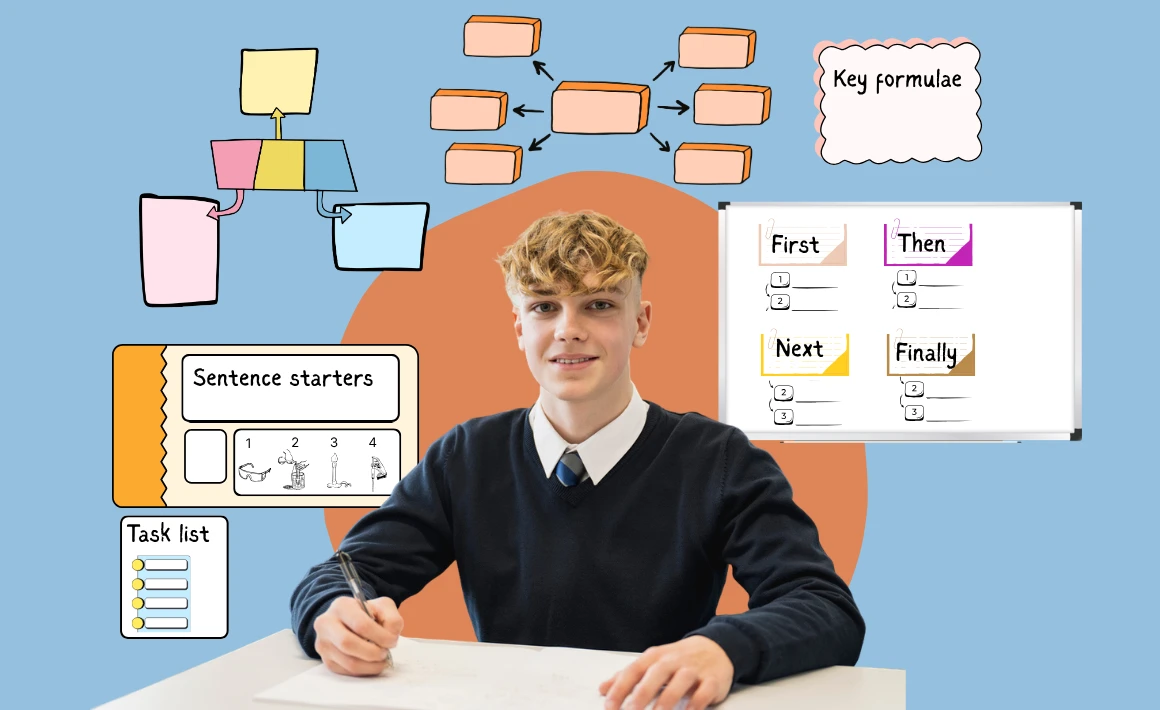
A task board is a good example of that. It is not flashy. It does not require a new platform, a consultant day rate, or a colour-coded folder that gets launched in September and quietly dies by October half-term. At its simplest, it is a clear sequence of steps: first, next, then, finally. A visual route through the task.
And yet, for some autistic pupils in secondary classrooms, that small piece of structure can be the difference between sitting stuck and getting started.
One teacher described this kind of support as “not a silver bullet, but for some students, it’s a quiet little miracle.” That phrase stayed with me, probably because it captures something we sometimes forget about inclusive practice.
Often, the most powerful changes are not loud, dramatic or expensive. They are thoughtful, consistent and rooted in what pupils actually need.
Not magic. Not a cure-all. Not another grand claim about transforming education overnight.
Just a small, practical adjustment that can make the classroom feel more predictable, more accessible and, frankly, less exhausting for pupils who spend much of the day trying to work out what is expected of them.
Why visual supports matter in secondary schools
Visual supports are often associated with primary classrooms or specialist settings. In secondary schools, they can sometimes be dismissed as too basic, too young, or somehow not academic enough.
I think that is a mistake.
Secondary schools are complex places. Pupils move between subjects, rooms, teachers, routines and expectations several times a day. The language changes. The layout changes. The task type changes. Even the unwritten rules change, depending on whose classroom they are in.
For many pupils, that is manageable. For some autistic pupils, particularly those who experience difficulties with executive functioning, working memory, processing speed, sensory regulation or anxiety, it can be a lot.
A teacher can give perfectly clear verbal instructions and still have pupils who have not fully processed them. That is not defiance. It is not laziness. It is not pupils “not listening”. Sometimes they have understood the first step but lost the second. Sometimes they are trying to hold too much information in their head. Sometimes they are waiting because they are anxious about getting it wrong.
That waiting matters.
Lost minutes at the start of a task add up quickly. If a pupil spends the first part of every lesson watching others, trying to decode the task, or waiting for an adult to repeat the instruction, they are not accessing the curriculum in the same way as their peers.
Visual supports help because they make the invisible visible. They break the task down. They reduce the demand on memory. They give pupils something stable to return to without needing to ask, again, “What do I do now?”
That small shift can protect dignity as well as support learning.
What task boards can look like
A task board in a secondary classroom does not need to be complicated. In fact, the moment it becomes complicated, we have probably missed the point.
It might be as simple as:
First: read the model answer.
Next: highlight three key features.
Then: write your own paragraph using the sentence starters.
Finally: check your work against the success criteria.
In another lesson, it might be a visual checklist for a science practical. In maths, it might show the order of steps in solving an equation. In history, it might support pupils to move from source analysis to written explanation. In English, it might help pupils structure an extended response without needing repeated adult prompting.
The format can vary. It should vary.
A good task board is not about producing one perfect template for every subject. That rarely works. What matters is the principle behind it: clear sequence, reduced ambiguity, manageable steps and a visible outcome.
Done well, it gives pupils a way into the work.
And sometimes that is the bit we underestimate. We can spend so much time thinking about stretch, challenge and outcomes that we forget to ask whether every pupil can actually get started.
The link with cognitive load and UDL
Cognitive Load Theory reminds us that working memory is limited. If a pupil is using most of that capacity trying to remember instructions, decode expectations or work out the order of a task, there is less capacity left for the actual learning.
That is especially important for pupils who already find transitions, language processing or task organisation difficult.
A task board acts as an external memory support. It holds the sequence, so the pupil does not have to. That means the pupil can focus more of their cognitive energy on the curriculum content rather than the logistics of the task.
Universal Design for Learning also gives us a useful way of thinking about this. UDL is not about lowering expectations. It is about removing unnecessary barriers so more pupils can access ambitious learning. Visual supports do this well because they offer information in more than one way. They support independence, reduce anxiety and allow pupils to monitor their own progress.
In other words, they are not an “extra”. They are part of good classroom design.
What the research process taught me
Last year I completed my Masters in Education with Real Training. Part of this provided the opportunity to carry out an action research project in my setting. The most useful learning from this work was not simply that task boards can help pupils. I already believed that visual supports had value. The deeper learning was about how inclusive practice actually becomes embedded in a school.
It is easy to write about inclusion in policy terms. It is much harder, and far more important, to make it visible in classrooms.
For me, this reinforced something important: Universal Design for Learning cannot be rolled out as a finished product. It is not a laminated checklist or a set of slides delivered once in CPD. It has to become a way of thinking. What is the barrier? What can we make clearer? How do we reduce unnecessary cognitive load? How do we support the pupil to become more independent without lowering the ambition?
It also reminded me that research in schools only matters if it changes practice. The best moments were not the neat findings or the tables of data. They were the small classroom moments that you only really notice when you are close to the work: a pupil starting without waiting; a teacher realising they had repeated themselves less; a student describing the board as “a checklist for my brain”; a colleague noticing that a strategy designed for autistic pupils was quietly supporting others too.
That is where practitioner enquiry becomes powerful. Not when it sits in a document, but when it changes the way we think about the next lesson.
Teacher ownership matters
One of the biggest lessons in rolling out any inclusive strategy is this: it cannot simply be done to teachers.
Schools are full of well-intentioned initiatives that made sense in a meeting, looked beautiful on a slide, and then collapsed the moment they met real classroom life. Teachers are already balancing curriculum demands, behaviour, assessment, marking, pastoral issues, workload and everything else that lands between 8:30 and 3:30.
So, if we want visual supports to work, we have to be realistic.
Staff need to understand the purpose. They need to see the benefit. They need examples that make sense in their subject. Most importantly, they need permission to adapt the approach rather than feeling they have been handed another non-negotiable template.
A history task board will not always look like a maths one. A science practical will need a different structure from a poetry analysis task.
A Year 7 class may need something more explicit than a Year 10 group. That is not inconsistency. That is responsive teaching.
The best implementation happens when we agree the principles, not when we police the formatting.
Teacher ownership is what moves a strategy from compliance to culture. When staff shape something, try it, refine it and see it work, it becomes part of their practice. Not because someone told them to do it, but because it helps.
That is the sweet spot.
Inclusion does not always need to be complicated
There is a tendency in education to make inclusion sound far more complicated than it needs to be.
Of course, some pupils need specialist support. Some need external agency involvement, therapeutic input, statutory assessment, personalised provision or significant environmental adjustments. We should never pretend that a task board replaces any of that.
It does not.
But we should also be honest about the power of everyday classroom practice. For many pupils, inclusion begins with clarity. It begins with knowing what is happening now and what comes next. It begins with not having to rely on an adult every few minutes. It begins with a classroom where expectations are visible rather than assumed.
A task board can say to a pupil:
- You do not have to hold all of this in your head.
- You can check.
- You can start.
- You can come back to the sequence.
- You can do this.
That matters.
It also matters that visual supports often help more pupils than the ones we originally had in mind. Pupils with ADHD, SEMH needs, EAL, low confidence or weaker working memory may all benefit from a clearer route through the task. So may pupils who are tired, anxious, distracted or simply unsure.
That is one of the strongest arguments for inclusive design. When we design carefully for pupils who experience the greatest barriers, we often improve the classroom for many others too.
Independence is not the same as leaving pupils to struggle
We talk a lot in schools about independence. We want pupils to become more independent learners, more resilient, more confident, more able to manage challenge.
That is right.
But independence does not develop by removing support and hoping for the best. It develops when support is structured in a way that can gradually be reduced, transferred or internalised.
For some autistic pupils, adult prompting becomes part of the lesson routine. The pupil waits. The adult repeats. The pupil starts. The adult checks. The pupil continues. Sometimes that support is necessary, but we need to ask whether it is building independence or simply maintaining dependence.
Visual supports can create a bridge.
Instead of repeating the instruction, the adult can redirect the pupil back to the board. Instead of hovering, they can step back. Instead of becoming the only source of clarity, they can point pupils towards a resource that helps them manage the task for themselves.
That is important for dignity. Many pupils do not want an adult standing beside them. They do not want to ask for help in front of their peers. They do not want to look different. A task board can provide support without making the pupil feel singled out.
It is subtle, but subtle matters.
A quiet miracle, but not a magic wand
I still like the phrase “quiet miracle”, but I would use it carefully.
Task boards are not magic. They will not remove every barrier for every autistic pupil. They will not compensate for poor relationships, unclear teaching, inaccessible curriculum design or a lack of wider SEND support. Poorly designed visual supports can become clutter. Overly wordy ones can increase cognitive load rather than reduce it. If they are introduced badly, they can become just another laminated initiative.
And education really does not need another laminated initiative.
But when task boards are used well, they can make a genuine difference.
Sometimes the most inclusive thing we can do is not to create something bigger, louder or more elaborate. Sometimes it is to make the next step clearer.
For the pupil who usually waits but starts, who usually needs repeated prompting but checks the board, who usually feels overwhelmed, but completes the task, that is more than a strategy.
It is access.
And access is where meaningful inclusion really begins.




What do you think?