Imogen Barber |
May 20, 2026
When children do not have access to a safe and secure environment in their formative years, this can have a profound impact on how they see themselves and their place in the world.
While secure attachment to a primary caregiver can promote healthy brain integration, insecure attachment can lead to heightened stress responses, affecting long-term social, emotional, and cognitive functioning.
By the time they reach school, a child’s attachment needs can affect their ability to learn. Signals from teachers could be misinterpreted and nervous systems are far quicker to enter “fight or flight” responses. The resulting impact on executive function can mean that struggles with working memory, organisational skills and ability to focus become commonplace.
Schools can play a crucial remedial role by adapting their approaches and applying attachment theory as a way to understand children’s behaviour. This means shifting focus away from “What’s wrong with this child?” to “How can we provide the appropriate security they need to thrive?‘”
In this blog we look at how this can be achieved, while recognising that every child is an individual.
Principles of Attachment Theory
Secure attachment is formed when an infant feels safe, trusted, and understood by their caregiver. This feeling develops into a healthy emotional bond, typically within the first 18 months of life. It acts as a secure base for exploration, fostering confidence, emotional regulation, and resilience. This attachment pattern is built through consistent, sensitive, and predictable responses from a caregiver to a baby’s needs.
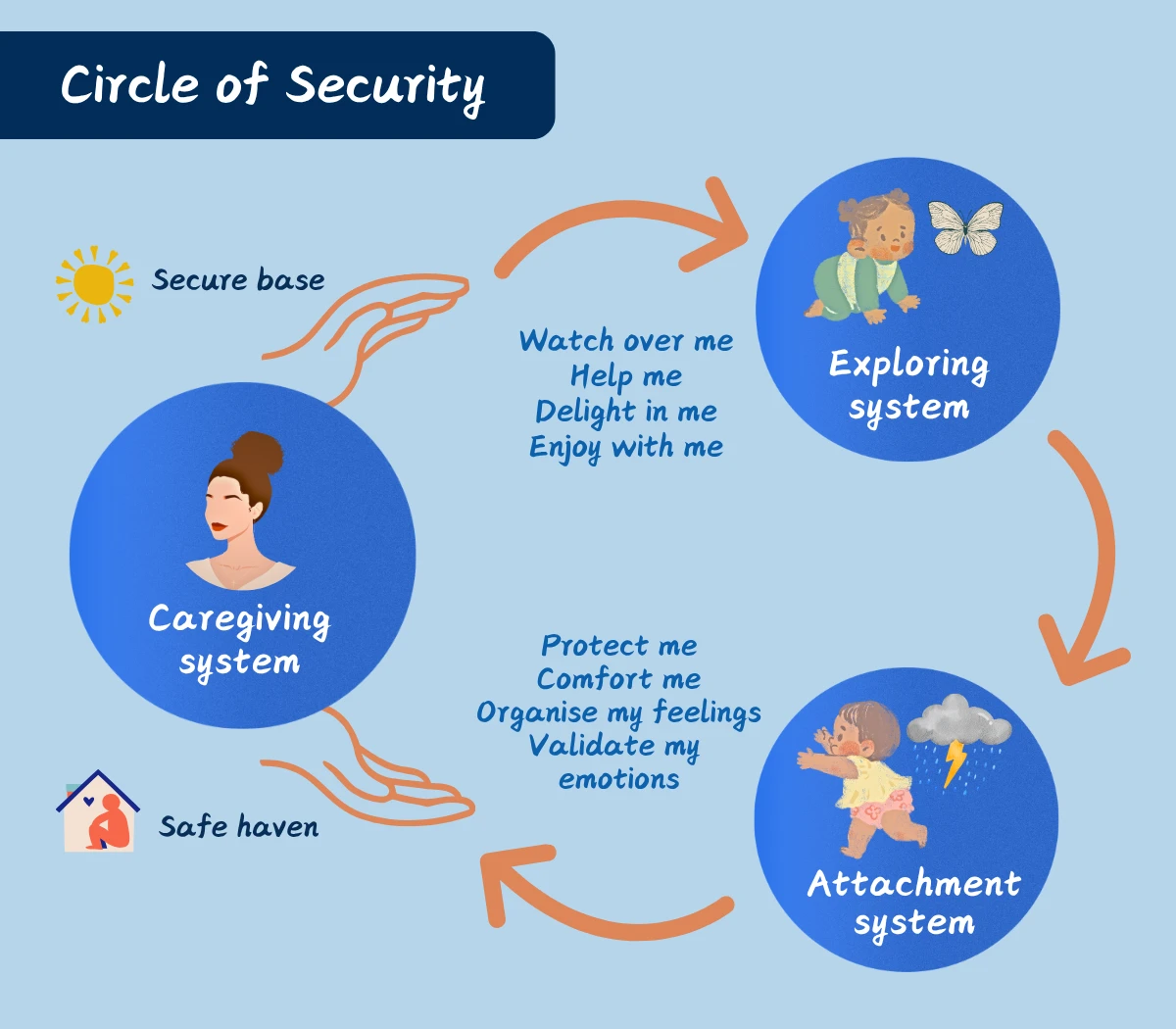
Circle of Security
The sequence of the child expressing a need and the caregiver’s response forms what’s called a Circle of Security within which the child grows. As long as that need is met relatively often by a parent or caregiver, trust develops.
The academic John Bowlby suggested that when a secure attachment exists, the baby develops an internal sense of calm that they can draw on when they encounter a stressful situation, using the mother as a “secure base”. He argued that humans attach to their caregiver for safety, not just food and warmth and that the quality of these relationships in the first two years of life can dictate a child’s later self-regulation and self-esteem.
After the age of one, children have already developed what Bowlby referred to as a functional “internal working model.” This becomes the archetypal narrative that a child creates around their own self-worth and relationship to others. The model is informed by their interactions with their primary caregiver.
Bowlby argued that the early years are a highly sensitive period for secure attachment to develop and that disruption to the mother-infant relationship or emotionally unavailable/inconsistent caregiving responses could have lasting implications for the rest of a child’s life.
The Strange Situation Test
Mary Ainsworth, a close friend of Bowlby, took his ideas and attempted to translate them into measurable data. By observing how infants aged 12 to 18 months reacted to a series of standardised stressors, including the entry of a stranger, the departure of the primary caregiver (usually the mother), and the crucial “reunion” moment, Ainsworth identified three distinct patterns of behaviour.
Securely attached infants: showed distress when their mother left, but were easily soothed upon her return, quickly using her as a “secure base” to regulate their nervous system and return to play.
Insecure-avoidant infants: appeared indifferent to their mother’s departure and actively avoided contact during the reunion. The child has learned that with this particular caregiver, crying won’t elicit a caregiving response so they suppress external signals of their distress.
Insecure-anxious infants: became intensely distressed by separation but were not easily comforted on their mother’s return or willing to return to exploring. They exhibited behaviour such as seeking closeness while simultaneously pushing the caregiver away or showing anger. Without a consistent caregiving pattern to draw upon, the infants were unsure whether their mother would successfully respond to their needs and help them to regulate, or whether they would be emotionally unavailable. The resulting anxiety causes their nervous system to become overwhelmed.
Later on, researchers also found that there was a small but consistent proportion of infants who didn’t fit any of the above. A fourth category, “disorganised” was added.
Criticism of the Strange Situation Test
Mary’s original concept of these attachment patterns, although foundational, has faced some criticism for its cultural bias, extreme focus on early maternal care, and deterministic view of development.
Critics also argue it pathologises diverse attachment styles and oversimplifies complex relationships by boxing individuals into rigid categories. Some toddlers, for example, have been observed to display apparently different attachment styles with different parents.
Why does learning about attachment theory matter for school staff?
Despite the complexity surrounding attachment theory, its core principles can prove highly relevant for anyone working in a school environment.
If staff move from seeing attachment as a means to label a child, and instead view it as a broader lens through which to understand behaviour as communication, the concept becomes incredibly useful. The key things to emphasise are;
- The behaviour patterns that children with attachment issues fall into can significantly impact their ability to learn. Some of the behaviour we identify as ‘difficult’ or ‘challenging’ may, in fact, be a result of heightened stress responses and anxiety rooted in early relationships. It needs to be approached with compassion.
- Our internal working model can be re-tuned. Studies have shown that attachment styles aren’t immutable. This is encouraging when you consider that children’s brains are incredibly “plastic” and much better able to form new neural connections than adults.
How then, can educational professionals go about helping children with attachment issues?
What to look out for:
While identifying an attachment style is best left to an educational or child psychologist, there are things that teachers and, in some circumstances, TAs can look out for that can help identify behavioural indicators of attachment issues.
This includes;
- reluctance to enter into trusting relationships with teachers or TAs
- conversely, behaviour that could be described as clingy or “attention seeking”
- low persistence in the face of challenge
- risk of being easily over-stimulated
- outbursts of anger
When a child’s internal view of themselves and the world is negative, they may also be more prone to:
- anxiety-driven behaviours (voice alterations, heightened sensory responses e.g flinching to touch, difficulties sitting still etc.)
- disorganisation – due to poor executive function (they may often be late or find it hard to hand in homework)
- difficulties with transitions
- struggles making and keeping friends
The Learning Triangle Model
Any classroom learning involves a child’s relationship with the teacher and the learning activity. Children learn best when they feel safe and secure in their relationship with the adult, which helps them to focus on the task.
The classroom learning context mirrors the Circle of Security between a child and caregiver explained earlier. In the same way an infant needs a secure base to explore, pupils need a secure base to learn.
Dr Helen Geddes’ “Learning Triangle Model” considers the three-way relationship between student, teacher and task. It is firmly based on the classic insecure avoidant, insecure anxious and disorganised attachment styles. However, if we resist the temptation to label these behaviours with attachment style categories and think about what the child is communicating, we can use this to make adjustments to the task and how we relate to the child in the learning context.
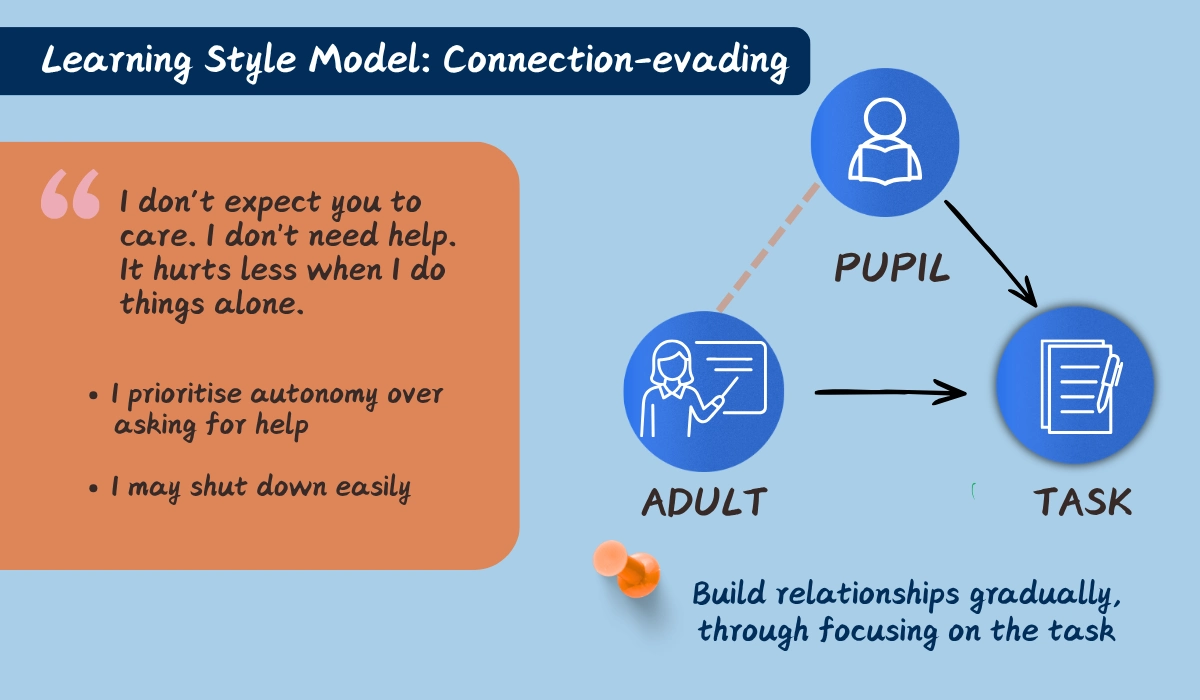
Supporting “connection-evading” behaviour
Geddes links this back to the insecure-avoidant attachment style, but the term “connection-evading”, may be more helpful as it encourages us to focus on the behaviour, not the label.
These individuals may play down their needs, always maintain a safe distance from others and rarely ask for help. They are, however, often masking high levels of anxiety. Connection-evading behaviour communicates that a pupil is finding it hard to trust in the relationship with the adult in the classroom and is more comfortable focussing on the task. They may also show a “flat” response to praise or criticism and behaviour such as avoiding eye contact.
KEY FOCUS: Use the task as the lever to build the relationship, as this is less threatening. Allow the pupil to develop their sense of independence and time to gain confidence in the safety and security of the adult present.
OTHER THINGS TO TRY:
- Sitting side-by-side or at an angle to the student. Look at the work together, rather than positioning yourself directly opposite them.
- The right balance of task autonomy and support: Break down tasks so they can do more things independently but also make them aware that you are available close nearby.
- Third-person language: Talk about the “character in the book” to discuss feelings or challenges indirectly.
- Low-pressure praise: Check with the student whether they are comfortable receiving positive feedback in front of the class or would rather it was done privately.
- Avoiding emotionally intense topics in 1:1s: until the student has built a secure relationship with you.
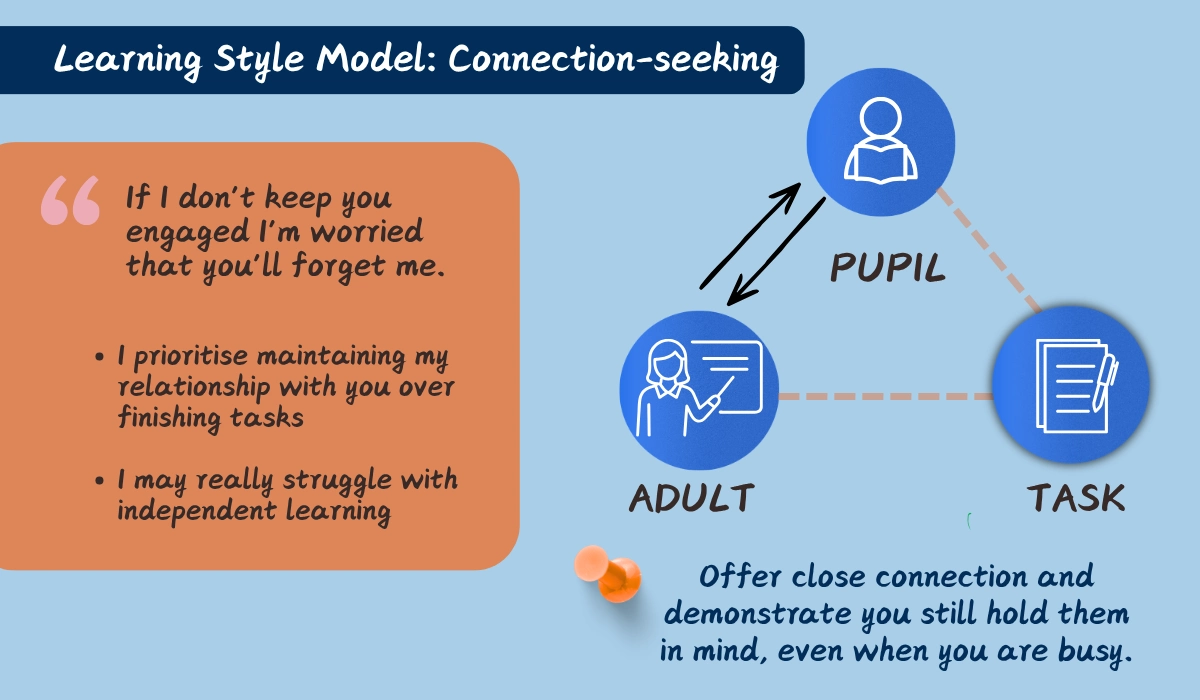
Supporting “connection-seeking” behaviour
This references the insecure-anxious attachment style. Again, if reframing this to focus on behaviour however, we could call this “connection-seeking”. These pupils are so focused on making sure that their relationship with the teacher is okay, that they’re not able to engage in the learning. These are the pupils often labelled as “attention seeking”. They may escalate behaviour to recapture attention if the teacher looks busy and find it hard to shift their attention from the teacher to the learning task.
KEY FOCUS: Continue building a close connection and provide reassurance that you are “holding them in mind,” even when you are busy.
OTHER THINGS TO TRY:
- Showing unconditional positive regard: This applies to all pupils, but may need to be made more overt/frequent for a connection-seeking student. The EMR (Establish Maintain Restore) approach recommended by the EEF is just one way of structuring little and often interaction. Building a “secure base” can start with simple things like showing interest in their life outside the classroom.
- Scaffolding independence: Foster self-reliance by briefly supporting a student at the start of a task before stepping away. Use subtle “proximity praise,” a quick glance, or a light touch to reassure them of your presence and availability as they work.
- Using memory cards/sticky notes: Writing a note and sticking it to the wall lets the pupil know that we’ve acknowledged what they wanted to ask or do, but will return to them when there’s time.
- Allocating clear roles and responsibilities for group work: Anxious pupils can come across as overbearing with peers so this may help.
Supporting “connection-distorting” behaviour
These children may have the most difficulty integrating thoughts and feelings. They may show inconsistent responses when relating to others. Geddes associates these pupils with the disorganised attachment category.
KEY FOCUS: Interventions will focus on creating levels of safety and predictability. In reality, many of the things listed below could also support many pupils with attachment issues, but they may especially help those displaying connection-distorting behaviour.
OTHER THINGS TO TRY:
- Transitional objects and timers, especially for younger children
- Visual timetables, to give predictability and five minute warning before transitions such as group work or demonstration.
- Social stories, to help re-enforce what we might expect when adults behave in a certain way and also to provide scripts for seeking support.
- Boosting choice and agency; this applies to both connection-distorting and connection-evading pupils.
- Remaining calm and predictable, so that children learn that your mood does not dictate their safety.
The three pillars of support
Regardless of what type of attachment behaviour a child may display, keeping the below in mind will help you deliver the most effective support.
Relational support. This can be as simple as using morning check-ins and creating meaningful moments of connection throughout the day. The quality of peer relationships is also really important for modulating attachment styles, so structured group activities, playground zoning, and things like lego therapy can help.
Safety and security. Creating stable, predictable environments and routines can lower anxiety, supported by trauma-informed techniques. Since transitions can cause insecurity, proactively planning for scheduled, unscheduled, and micro-transitions (like moving around the classroom) is crucial for pupil support.
Supporting a sense of self. Children need to know that we value them with all the baggage that they bring with them. This means modeling positive self-talk, helping them understand their emotions and recognising and praising when they have managed their emotions so that they’re able to build confidence in themselves.
Some things to remember:
Be explicit – are you frustrated with this task today?
Wonder aloud – I wonder if you’re feeling this way because (showing you are thinking about them without demanding a response)
Show connection – sometimes I feel like this too
Check understanding – are you thinking…..?
Systematic delivery of these techniques in a whole-school approach can make a positive impact. A 2022 meta-analysis of 305 schools undergoing attachment-aware training carried out by researchers from Oxford University revealed reductions in sanctions and improvements in headteacher-reported scores for pupil engagement, as well as wellbeing. Other studies have also reported improvements in academic performance and a decrease in exclusions.
Relevant courses
You can learn more about how to provide inclusive practice and interventions for the most vulnerable children in our Social and Emotional Mental Health Needs course. Leaders can also learn how to overcome barriers and fit attachment training into their overall mental health strategy in our Senior Mental Health Lead Advanced Award.
“It doesn’t help to react – you have to reflect” – Heather Geddes
Attachment problems may account for more behavioural difficulties in the classroom than we realise. Regardless of their age, children fundamentally need secure relationships to regulate their emotions and engage with learning.
Teachers often respond in the moment to challenging behaviour, but in an attachment-aware school, the ideal situation is to also be able to take a moment to step back and reflect on why it might be happening.
Sometimes this might involve helping children to articulate their feelings; other times it could be adjusting how we present the task.
Adults often worry that talking about some of these challenging areas will make things worse for young people and increase their anxiety. Typically, however, the reverse is true. What we often find is that it reduces their levels of uncertainty and increases their sense of security.
We must be proactive in our approach because the long-term risks are significant: often children who have difficulties with attachment can internalise those difficult feelings. This can not only impact academic achievement, but later on, can also lead to significant mental health difficulties, such as self-harm, anxiety, and depression.
As school professionals, providing a secure base for these children today means that we are protecting their ability to learn in the present and their wellbeing in the future.
References and useful reading
Bergin, C. & Bergin, D. (2009). Attachment in the classroom. Educational Psychology Review, 21, 141-170.
Bomber, L. (2007). Inside I’m hurting; Practical strategies for supporting children with attachment difficulties in schools. London: Worth Publishing.
Bomber, L (2011). What about me? Inclusive strategies to support pupils with attachment difficulties make it through the school day. London: Worth Publishing.
Bowlby, J. (1988). A secure base: Parent-child attachment and healthy human development. London: Routledge.
Geddes, H. (2006). Attachment in the Classroom. Worth Publishing.
Gerhardt, S. (2004). Why Love Matters: How Affection Shapes a Baby’s Brain. Routledge.
Madigan, S., Fearon, R. M. P., van IJzendoorn, M. H., Duschinsky, R., Schuengel, C., Bakermans-Kranenburg, M. J., Ly, A., Cooke, J. E., Deneault, A.-A., Oosterman, M. and Verhage, M. L. (2023) ‘The first 20,000 strange situation procedures: A meta-analytic review’, Psychological Bulletin, 149(1-2), pp. 99–132.




What do you think?