
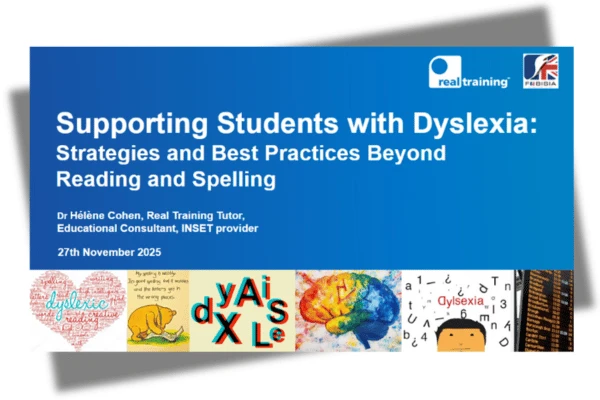
This webinar was held in partnership with FOBISIA. Dr Hélène Cohen provided her first-hand insight into the struggles dyslexic learners can face in the classroom.
Key topics covered included:
- Understanding the challenges dyslexic pupils face – including reading, writing and spelling, but also looking at number confusion, organisational skills, remembering sequences, and other challenges brought about by processing and working memory difficulties.
- Understanding co-occurring needs – the overlap between ADHD, autism, dyspraxia and dyslexia
- Alternative ways to assess writing and spelling – including a new formula to assess progress using a free-writing exercise
- Practical strategies to support students – from managing reading around the class, to spelling in context, using processing cues, ways to present passages of text and tips for encouraging study skills
- Building self-esteem – understanding triggers, the vortex of dyslexia anxiety, how to get the child’s true voice and creative ways to support them
Access the slides
View the recording
Your questions answered by Hélène
Q: Do you have any advice for supporting newly diagnosed secondary students?
Hélène: “Firstly, it’s about making sure they understand their diagnosis, and that it doesn’t become an excuse to not do their work, and say, look, this is about how you present it. Many of the strategies I’ve covered in the presentation will work for secondary students, chunking information and making it visual, tactile and interactive if possible.
When I taught Shakespeare in a dyslexia provision, we were looking at Macbeth and we got the students to make spoon puppets of all the characters. They then acted out the storyline to a primary school using the puppets that they’d made. This not only meant, because they were presenting it to another audience, they learned it better, but they were doing something physical. We also acted out one of the scenes between Lady Macbeth and Macbeth, in the form of EastEnders characters. So myself and a colleague of mine acted it out and involved the pupils. So there are lots of creative things that can be done.
Q: How can we help EAL learners when we don’t know whether the challenges are to do with dyslexia or learning in a foreign language?
Hélène: “Firstly, it’s about addressing the needs that they’re facing. Are they understanding what they’re reading, or simply decoding it? If they’re having trouble with the decoding itself, it’s more likely to be something like dyslexia. But if they’re having trouble with the comprehension, it could be a speech-language issue. If you’re looking for speech and language, you do need to be assessed in your native tongue, the one that you use most of the time. In international settings, we have third culture kids, we have people who maybe have English they’re using in school, but their mother is French, their father is German, and they’ve got all of these languages. Which is their prime language? We need to find the language in which they are most comfortable, and do the assessments in those languages.
Q: What’s your opinion on the Toe-by-Toe approach? Would you recommend it?
Hélène: “Yes. One of the things it’s good for is the fact that it is a daily thing, and it doesn’t take long. It can be 10 minutes a day. It’s something you can do maybe during registration period, or during an assembly. It’s also very easy to train up somebody else to deliver it. It doesn’t have to be you. Some people get them to do it at home with their parents. It depends on the situation, but Toe-by-Toe is really good. What’s important is, if it’s somebody who’s older, that they haven’t used it already. It’s about not using whatever they used in primary if they’re in secondary. There are now some really good books as well, aimed at older children, but in simplified language. Barrington Stoke do a lot of those. Really, really good to get those sorts of books, but Toe by Toe, I would strongly recommend it. It’s a very good approach.”
Q: How would you help a Year 6 student who has dyslexia, is behind in speech and language and also had early hearing loss? Her current comprehension is around Year 2 / Year 3. I’m doing a Year 2 / 3 intervention, but she’s struggling to cope.
Hélène: Okay, the out-of-class sessions are great. What we need to do is make sure that the work is accessible to her in class. I don’t know if you know about Widgets where you have pictures that accompany the words? This could be helpful, depending on what lesson we’re talking about. It’s important for that person to get the content, even if the language has to be simplified. So think about what it is that you want her to learn. If it’s history, then let’s have some pictures, communicate in print, do different banks of images, depending on the topic. So it’s about getting that balance. We need to know – where is her intellect level? Just because the speech and language is an issue doesn’t mean that her intellect is low. So what is it she’s finding difficult? If it’s just speech and language and dyslexia and the written word, then you can work on it by using a lot of images, doing things practically, and so on.
If you’re doing out-of-class sessions, do things that are physical. So, for example, writing words using water in a washing up bottle. Doing things in a tactile way. Make words out of plasticine and things like that. Just as many physical ways as you can do it. Make sure that within class, you look at what it is we want her to learn in this lesson, how can we simplify it? How can we make it accessible?
How can we help students with both dyslexia and ADHD – particularly when it comes to blending longer words and trouble formulating thoughts when speaking out loud? I have one student in particular struggling with this.
I wouldn’t have that pupil reading in front of anybody, I really wouldn’t. When it comes to talking, just talking, say, let’s talk at the end, and find a time. Don’t say, “let’s talk” if you don’t have time. You have to actually give them that time – this is really important to help build their confidence. Other ways of improving their reading and speaking is to give that pupil 10 minutes a day on a one-to-one basis. That will give them a lot more confidence, and one-to-one work will take away some of the stress – doing things in front of the class is much, much harder.
Useful resources:
Free Writing Analysis tool: Available to download from www.pleasemissplease.co.uk.
My book: S.E.N.D. Help. Available to purchase from Amazon here.
Study tips for dyslexic learners: Take a look at these video tips (designed for adults but good for older learners as well).
Supporting children with ADHD and dyslexia: A short article here from Dyslexia Action
Further reading
DfE/DoH (2015) Special Educational Needs and Disabilities Code of Practice: 25 Years. Crown. Available at: https://www.gov.uk/government/publications/send-code-of-practice-0-to-25. (Accessed 05/02/2025)
Gov UK (no date) Definition of disability under the Equality Act 2010. Available at: https://www.gov.uk/definition-of-disability-under-equality-act-2010. (Accessed 01/02/2025)
Lamb, B. (2009) The Lamb Inquiry.Available at: https://dera.ioe.ac.uk/id/eprint/9042/1/Lamb%20Inquiry%20Review%20of%20SEN%20and%20Disability%20Information.pdf. (Accessed 03/02/2005)
Pollock, J., Waller, E. (2004) Day-to-Day Dyslexia in the Classroom 2nd Edition. Routledge Taylor Francis.
Power, K., Forsyth, I. (2018). The Illustrated Guide to Dyslexia and its Amazing People. Jessica Kingsley Publishers
Reay, D. & Wiliam, D, (1999) ”I’ll be a nothing’: structure, agency and the construction of identity through assessment ‘, British Educational Research Journal, 25: 3, 343 — 354
Rief, S. (1993) How to Reach and Teach ADD/ADHD Children. New York: The Centre for Applied Research in Education
Rowntree, D. (1987) Assessing Students, How Shall we Know Them? 2nd Edition. Kogan Page London
Tomlinson, R. https://twitter.com/BarrowfordHead Heard on, Radio 4, Woman’s Hour 10am 15/07/14 http://www.bbc.co.uk/programmes/b0496c07
More about our online courses….
Gain in-depth knowledge about special educational needs, choosing from a wide range of modules to suit your interests and needs in your setting on our Masters in SEND and Inclusion course.
If you are a looking for a shorter course you might want to consider our International Award in SEN Coordination (iSENCO). The iSENCO award has been developed especially for SEND professionals working in international schools who want to build their leadership skills, promote inclusion and deepen their knowledge of SEND.
Spotlighted shorter courses:
- Certificate of Competence in Educational Testing (CCET) – teaches you how to administer, select and evaluate a range of educational tests and assessments. This can be taken as a standalone course or as the first part of our CPT3A course which will qualify you to become an exam access arrangements assessor. It can also be part of your longer training route to becomming a qualified Dyslexia Assessor.
- Autism Spectrum Conditions – deepens your understanding of autism and appropriate adaptations.
- Maths courses – our Mathematical Understanding and Teaching Methods and Maths Teaching and Intervention planning help Primary and Secondary school teachers support learners with maths difficulties including dyscalculia.
- Auditing and Leading Improvement – helps you evaluate SEND provision and roll out changes with confidence.
From our sister company, Dyslexia Action:
- Train to become a specialist teacher/practitioner with the Level 5 Diploma in Specialist Teaching for Literacy Related Difficulties
- Deepen your knowledge and train to become a Dyslexia Assessor with our Level 7 Qualifications
- Boost your knowledge of dyslexia with our certified short CPD courses and gain a Certificate or Award.